Omar Kelly: Hopefully Dolphins don't repeat the Mike Tomlin mistake
Published in Football
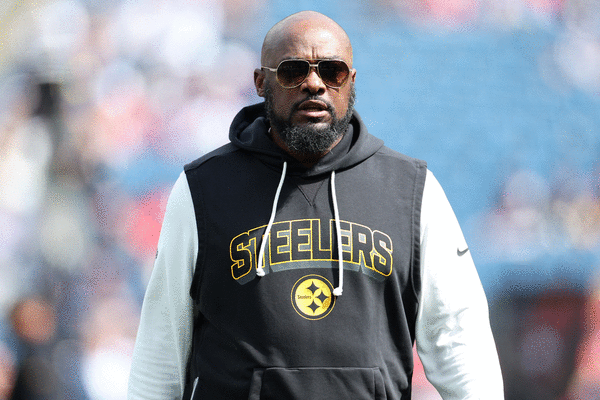
MIAMI — Mike Tomlin has not only been a pillar of granite for the Pittsburgh Steelers franchise for 19 seasons, but he has also been a painful reminder of one of the Miami Dolphins’ biggest missteps that took place nearly two decades ago.
I’m referring to a mind-set this franchise’s decision makers had back in 2007, right after Nick Saban abruptly left South Florida’s NFL franchise to become the head coach of the University of Alabama.
That left Miami, which at that time was one of the NFL’s most iconic franchises, searching for someone to help the team escape mediocrity.
Wayne H. Huizenga, the owner at that time, put together a search committee to find Saban’s replacement, and a young African-American defensive coordinator for the Minnesota Vikings was on that list.
The NFL had instituted the Rooney Rule in 2003, which required all teams to interview at least one minority for the head coach and general manager position before hiring someone, and the Dolphins were seemingly checking the box by interviewing Tomlin.
But what happened in the interview stunned everyone. Tomlin left a lasting impression on certain members of that search committee.
He had a presence.
He had ideas and plans that many on the committee liked, but the Dolphins entered the process with a vision of hiring an offensive-minded head coach. To satisfy that agenda they granted Cam Cameron, who was then the offensive coordinator for the playoff-bound San Diego Chargers, a second interview because he had supposedly bombed the first.
Ultimately, the decision came down to Tomlin and Cameron, and the committee chose Cameron, and justified it privately by explaining that Tomlin was “too hip-hop.”
The Steelers, which are owned by the Rooney family, the individual the [Art] Rooney Rule was named after, were also searching for Bill Cowher’s replacement, and days after Miami made its decision Pittsburgh hired Tomlin, who has gone on to produce a 190-113-2 record with the Steelers, which includes 12 playoff berths and one Super Bowl win.
He has become a coaching legend while the Dolphins have been riding the mediocrity merry-go-round ever since.
There are two important lessons to learn here.
The first is that it’s critical to enter the hiring process open-minded and not have a front-runner, or type of individual you want to hire in mind. This applies to the real world just as much as it applies to sports.
We all know how promotions and many hiring processes work [or doesn’t].
The Dolphins went into the process with the type of coach they wanted to hire, and didn’t enter the process open-minded.
The franchise learned that lesson the hard way because Cameron was a complete failure as a head coach for one season, where he won one game before being fired.
The second is that minorities — not just black people, and not just males — often have to work twice as hard to get a fair shake in many industries because of conscious, or unconscious biases.
I have spent nearly two decades trying to figure out what’s “too hip-hop?”
Life eventually taught me it’s being authentically black, or a person of color who doesn’t code switch.
It’s not minimizing who you are to make others more comfortable.
Keep in mind, this was two years before Steve Ross’ tenure as Miami’s majority owner started.
Ross had nothing to do with the Dolphins in January of 2007, when Tomlin was interviewed by Miami’s search committee.
And the reality is, Ross has gone out his way to open doors for minorities in football throughout his 18 years as Dolphins owner.
The first person he elevated as an interim coach was Todd Bowles, who has gone on to lead two NFL franchises since.
He elevated Dawn Aponte, a female executive who had worked her way up the ranks in the NFL for 17 years, to be Miami’s top executive in 2010, during the Joe Philbin era.
For this, the Dolphins were consistently mocked by NFL insiders for seven years because the football people had to “answer to a woman.”
Aponte was later removed when Mike Tannenbaum took over as team vice president in 2019, but Ross encouraged the NFL to hire her in its front office, where she’s presently the third most-powerful person in the league office as Chief Administrator of the league.
Ross promoted Chris Grier to general manager in 2016 and kept him far too long in that role before firing him in October.
Ross also hired Brian Flores as a first-time head coach in 2019.
Even though that relationship went south, and has led to a pretty nasty discrimination class-action lawsuit the Dolphins and the league are still fighting, Ross gave Flores the franchise’s first fully guaranteed contract for a head coach, and granted him just about everything he asked for during his three seasons.
And finally, despite his appearance — looks, not style or mannerisms — Mike McDaniel is considered a minority because his father’s African-American.
Ross also just made Champ Kelly, an African-American, the interim general manager when Grier was removed.
Ross’ track record has proven he’s about breaking down barriers, which is why I can’t help but wonder what would have happened if he had to choose between Cameron and Tomlin.
Or better yet, what might happen if Tomlin becomes available, either via trade or if/when the Rooneys seek a fresh start and fire him at season’s end because Pittsburgh’s fan base is demanding change.
Tomlin has never had a losing season as a head coach, and has the Steelers in position to win the AFC North again heading into Monday night’s nationally televised game against the Dolphins.
He’s at the mountain top when it comes to his field, and he has earned everything he has achieved, with or without hip-hop.
One of my most scarring memories was of a fifth-grade teacher who worked hard to keep me out of an elevated-level class I had been in since first grade because of my talkative and argumentative reputation (things haven’t changed), telling me if I didn’t learn to behave better (do what she said without questioning her) I’d end up on drugs, in jail, or dead by the age of 24.
That critique wounded me for life.
As I grew older, I realized that’s what many brown boys had been told by a teacher, administrator, or authority figure at one point in their lives before adulthood.
That’s what being “too hip-hop” gets us.
It’s being a melanated person and dealing with racial biases against you, which are sometimes overt, but usually subtle.
In any other industry, a leader who has a dominant presence, and comes across confident — and maybe aggressive or arrogant — is seen as an asset. In the NFL that person is probably described as an alpha male, a dawg.
Back then, and probably still today, for a black male to emanate that, especially in the presence of powerful white figures, it’s threatening.
Maybe intimidating, and probably “too hip-hop.”
____
©2025 Miami Herald. Visit miamiherald.com. Distributed by Tribune Content Agency, LLC.






Comments