2026 NFL mock draft: Combine risers and a blockbuster trade shake up the first two rounds
Published in Football
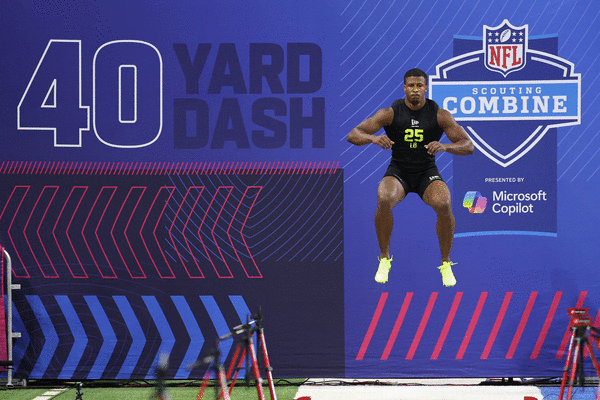
The NFL scouting combine always claims to provide clarity.
What it actually delivers is a fresh set of arguments inside draft rooms across the league. Forty-yard dashes get dissected, arm lengths get debated, and somewhere along the way a few prospects quietly climb ten spots on someone’s board.
This year’s biggest winner might have been Ohio State’s Sonny Styles, who delivered one of the most outrageous athletic profiles scouts have seen in years.
At 6-foot-5 and 244 pounds, Styles ran a 4.46-second 40-yard dash with a 1.56 split, then posted a 43 1/2-inch vertical and an 11-foot-2 broad jump.
In other words: edge rusher size, linebacker tenacity, safety explosiveness and the kind of testing numbers that make defensive coordinators develop overactive imaginations.
Speed also stole the show, as per usual, especially since most of the “slowpokes” decided to sit this one out.
Mississippi State receiver Brenen Thompson arrived as a niche deep threat and gadget guy, but likely earned some extra cashola in Indianapolis after blazing a 4.26 with a 1.54 split. Meanwhile, big-bodied wideout Jeff Caldwell of Cincinnati delivered the rare “create-a-player” combination: 6-foot-5, 216 pounds with a 4.31 40, an insane 1.48 split, 42-inch vertical and 11-foot-2 broad jump.
And then there are the combine casualties.
Notre Dame receiver Malachi Fields struggled through testing after a strong Senior Bowl, posting a disappointing 40 time and battling drops in the gauntlet drill. Fields’ performance could revive questions about his separation ability.
Miami edge rusher Rueben Bain Jr. was one of the most dominant defenders in college football last season, but his arm length measurement (30 7/8 inches) immediately became a talking point among scouts who worry about how it translates when stacking and shedding NFL tackles.
Highly-productive Texas A&M edge rusher Cashius Howell left Indy in the same boat as Bain. Howell’s 30 1/4-inch arms raised concerns about how he’ll disengage from NFL tackles despite testing that showcased his elite speed and good explosion.
Both Bain and Howell were considered locks to be selected in the first round by most of us draftniks ahead of the combine.
We’ll see who wavers going forward.
Ask 10 scouts what the combine changed and you’ll get 10 different answers. But speed gets paid, traits get drafted and every year someone climbs the board because of one week in Indianapolis.
With the stopwatch heroes crowned and the measurements logged, here’s how the first two rounds might look. At least until a pro day throws another wrench into everything.
Here are some key dates going forward before we get to the draft in Pittsburgh (April 23-25):
— Early March: Colleges can begin hosting pro days
— March 11: New league year begins at 1 p.m. (i.e. free agency)
MOCK PREAMBLE
This is an attempt at figuring out the best players available in this season’s draft class, and which teams they’d match up well with considering the current draft order courtesy of NFL.com. The closer we get to draft day, the more I’ll attempt to match what teams will actually do with their draft picks as opposed to what I believe they should do.
According to The Huddle Report, I was the second-most accurate NFL draft prognosticator in print last season. I tied for first overall (out of 172) covering a five-year period between 2019 and 2023.
Considering the NFL doesn’t have an offseason, the draft has become the Super Bowl of the league’s second season, and a mock version of said draft is meant to educate, perhaps even entertain. At very least, it helps you pass the time.
Follow me on X (formerly known as Twitter) @UTEddieBrown so we can continue the conversation.
Here’s an updated version of my 2026 NFL Mock Draft after the combine, including the first two rounds:
FIRST ROUND
— 1. Las Vegas (3-14) — Fernando Mendoza, QB, Indiana, Jr.
“Let’s revisit this next year” is not a team-building strategy. That’s why this feels like a lock barring another team making a “Godfather” offer for the pick. Mendoza wins with size, command, accuracy, red-zone efficiency and grown-man composure. The questions are real — middle-of-field volume, under-center experience, and whether his game has enough improv juice when structure collapses — but the résumé is too strong to shrug off. New Raiders head coach Klint Kubiak’s offensive philosophy pairs nicely with Mendoza’s skill set. Top needs: QB, Edge, WR
— 2. N.Y. Jets (3-14) — Arvell Reese, LB, Ohio State, Jr.
Perhaps GM Darren Mougey packages this selection and the No. 16 overall pick in a swap with the Raiders for Mendoza. Otherwise, the Jets need to replenish their defense after trading their two best defenders away at the deadline. The 6-foot-4, 243-pound uber-athletic Reese is a modern defensive problem-solver: long, explosive, versatile and productive enough to justify the hype. The questions are about polish and role definition, not talent. Top needs: QB, CB, WR
— 3. Arizona (3-14) — Jeremiyah Love, RB, Notre Dame, Jr.
The Cardinals will release Kyler Murray, but they’re not finding his replacement with the third-overall pick. Adding an explosive player like Love would help take pressure off the passing game in the interim. Love features elite size (6-0, 214), patience and balance on top of home run capability. When he gets daylight, the play can be over before the safety finishes his bad decision. Top needs: QB, OL, DL
— 4. Tennessee (3-14) — Carnell Tate, WR, Ohio State, Jr.
Traditionally after drafting a franchise QB with the first overall pick in the previous draft, an organization will utilize the next draft to stockpile offensive talent in support of their investment. Cam Ward needs someone who can tilt coverage instead of just participating in routes. Tate showed immense growth in his technical skills last season, especially his route running, which transformed him from a vertical threat to a more complete receiver who can threaten a defense at all three levels. His official 4.53 40 created noise because some evaluators reportedly had him faster on handheld timing, but the only official number is the official number. Tate’s tape says he has enough play speed. Top needs: WR, OL, CB
— 5. N.Y. Giants (4-13) — Sonny Styles, LB, Ohio State, Sr.
The Titans and Giants are in the same boat. Both have talented quarterbacks headed into their second season in need of support. GM Joe Schoen will need to reinforce Jaxson Dart’s protection, weaponry, and perhaps teach him how to slide to maximize his potential. Considering John Harbaugh’s history with the Ravens, though, I’m thinking he’d prefer to address the O-line or even a dynamic defender like Caleb Downs or Styles. Styles wins with athleticism, instincts, and legitimate finishing power, and his background as a safety gives him answers a lot of linebackers simply do not have. Top needs: WR, DL, G
— 6. Cleveland (5-12) — Spencer Fano, T, Utah, Jr.
GM Andrew Berry just traded a fifth-round pick to the Texans for Tytus Howard, and signed him to a three-year, $63 million extension. But that’s just the beginning of Berry’s work to revamp the Browns’ O-line. Fano is a big (6-6, 302), powerful, athletic anchor in the run game, and his footwork improved in pass protection his junior season. Whether he sticks at tackle or eventually slides inside may depend on the team, but the broader point is simpler: Fano looks like an NFL starter. Top needs: QB, OL, WR
— 7. Washington (5-12) — David Bailey, Edge, Texas Tech, Sr.
The Commanders need a true problem-creator off the edge. Bailey tied for first in the FBS with 14 1/2 sacks, and was second with 19 1/2 tackles for loss. He has rare speed for someone who is 6-3, 250. The selling point is simple: he gets to quarterbacks, and he does it a lot. Top needs: Edge, DB, WR
— 8. New Orleans (6-11) — Rueben Bain Jr., Edge, Miami, Jr.
The defensive front needs a fresh coat of paint. The 6-foot-3, 275-pound Bain wins with power, leverage, technique, and a mean streak that shows up snap after snap. The lack of ideal length is real, and it will scare off some teams. But the résumé, disruption, and polish are also real. Top needs: WR, G, DL
— 9. Kansas City (6-11) — Francis Mauigoa, T, Miami, Jr.
The Chiefs’ dynasty may be over, but the championship window will remain wide open as long as Patrick Mahomes is upright and healthy. Mahomes is magic, but even magicians prefer clean pockets. GM Brett Veach added an extra first-rounder to the coffers by dealing two-time All-Pro cornerback Trent McDuffie to the Rams on Wednesday. Perhaps the trade is a precursor to Veach moving up in this draft to secure Jeremiyah Love or a top-tier defender like Arvell Reese, David Bailey or Rueben Bain. If so, I imagine Veach would touch base with his buddy, and former assistant, Mike Borgonzi to see if the Titans have any interest in moving down. Stockpiling more picks would help Tennessee’s front office achieve their stated goal of making 30 draft picks in its first three years, including 12 in the top 100. We shall see. Otherwise, Mauigoa, a former five-star recruit, is big (6-6, 335), powerful, athletic enough and plays with a mauling mentality at the tackle position. There are scouts who believe he’d be even better on the interior, but he’s talented enough to stay at tackle. Mauigoa anchored one of the nation’s better offensive lines in his final year with the Hurricanes and put together the kind of pass-protection season that gets line coaches misty-eyed. Top needs: DL, RB, T
— 10. Cincinnati (6-11) — Mansoor Delane, CB, LSU, Sr.
Outside of cornerback DJ Turner, and two talented rookie linebackers, Demetrius Knight Jr. and Barrett Carter, who survived their growing pains last season, what part of the Bengals’ defense doesn’t need to be completely overhauled? Delane doesn’t have elite size (5-11, 187) or deep speed, but he’s sticky, instinctual and can play multiple positions in the secondary. He wasn’t a one-year wonder who came out of nowhere in Baton Rouge. He played real football early at Virginia Tech, then upgraded competition and still looked like a Sunday player in the SEC. He’d pair nicely with Turner. Top needs: Edge, DB, G
— 11. Miami (7-10) — Olaivavega Ioane, G, Penn State, Jr.
Cornerback may be the biggest position of need for the Dolphins depending on how new GM Jon-Eric Sullivan and head coach Jeff Hafley feel about Tua Tagovailoa as their QB going forward, but the O-line needs to become a feature, not a disclaimer. Ioane was one of the few bright spots for the Nittany Lions last season, earning second-team AP All-American recognition. He’s an elite pass-blocker and a strong anchor in the run game, while featuring impressive movement skills for a man his size (6-4, 330). Top needs: CB, WR, G
— 12. Dallas (7-9-1) — Caleb Downs, S, Ohio State, Jr.
The Cowboys’ entire offseason, and especially the draft, will be all about improving the defense. Downs was the heart and soul of a Buckeyes defense that led the nation in points (9.3) and yards allowed (219.1) per game, and he finished ninth in the Heisman voting. He plays fast, thinks faster, and hits like he’s trying to invoice the ball carrier. Combine week brought public rumor mill chaos about his knee; reporting also noted his family and some insiders pushed back hard on it as misinformation. Either way, teams will do their own due diligence. Top needs: LB, DB, Edge
— 13. L.A. Rams from Atlanta (8-9) — Monroe Freeling, T, Georgia, Jr.
Rob Havenstein’s retirement means the right side needs a plan now, not later. Freeling features rare lateral movement skills for a tackle his size (6-7, 315). His combine numbers were elite enough to produce a near-perfect 9.99 Relative Athletic Score. He needs polish, but Freeling is a classic traits-plus-SEC-production tackle prospect: long, explosive, and athletic enough to make coaches believe they can unlock something big. Top needs: DB, OL, QB
— 14. Baltimore (8-9) — Jermod McCoy, CB, Tennessee, Jr.
The mandate for the Ravens will be clear this offseason: fix the defense. Hiring former Chargers defensive coordinator Jesse Minter to be head coach certainly seems to suggest as much. You can never have enough corners in the AFC, especially if your pass rush is still under construction. McCoy earned first-team All-SEC recognition in 2024 with four interceptions for the Vols after transferring from Oregon State before tearing his ACL during an offseason training session last January. His tape showed elite ball skills with fluid athleticism and explosive closing speed. If the medicals check out and the movement looks right at his pro day, McCoy’s the type of talent who usually goes in the top half of the first round. Top needs: Edge, WR, C
— 15. Tampa Bay (8-9) — Kenyon Sadiq, TE, Oregon, Jr.
A dynamic option at tight end would help the offense, especially if Mike Evans ends up leaving in free agency. A 4.39 40 at 241 pounds is cartoon stuff for the position, and the jump numbers only reinforce it. Sadiq is a legitimate field-stretcher who can line up attached, in the slot, split out wide, or in the backfield, which gives play-callers real flexibility. Plus, he has legit upside as a run-blocker in the pros. The questions are about size, hands consistency, and whether his production always matched the traits. Top needs: Edge, LB, G
— 16. N.Y. Jets from Indianapolis (8-9) — Makai Lemon, WR, USC, Jr.
Pairing Lemon with Garrett Wilson would set the Jets’ next franchise QB up for success, whomever he may be. Lemon (5-11, 192) is a quick, efficient route runner who is a demon in the slot and capable of frustrating tacklers with his abilities after the catch. He already wins like a pro. He varies tempo, understands leverage, and wastes very little movement in and out of breaks. Lemon is explosive, but he isn’t just going to run by everybody. Top needs: QB, CB, WR
— 17. Detroit (9-8) — Caleb Banks, DL, Florida, Sr.
The Lions ranked 13th overall in stopping the run last season, but struggled mightily down the stretch. If D.J. Reader leaves in free agency, there will be a huge hole to fill on the interior defensive line. Banks looks like a prototype at 6-foot-6, 327 pounds with 35-inch arms, and he backed up the frame at the combine with a 5.05-second 40 and 32-inch vertical. That is rare movement for a man built like a loading dock. Banks is a classic projection-versus-production debate wrapped in a premium NFL body. The concerns are durability, consistency, and whether the disruption turns into enough finishing. The ceiling is obvious. Top needs: Edge, CB, C
— 18. Minnesota (9-8) — Dillon Thieneman, S, Oregon, Jr.
The Vikings need more stability and playmaking on the back end, especially if Harrison Smith calls it quits. Thieneman is a do-it-all safety with verified NFL athleticism, real ball production, and enough versatility to be a coordinator’s favorite toy. The only real question is where you want him living — deep, down, or in motion. The answer is usually: yes. Top needs: DB, DL, OL
— 19. Carolina (8-9) — Kadyn Proctor, T, Alabama, Jr.
Former top-10 pick Ikem Ekwonu is entering the final year of his rookie contract after suffering a ruptured patellar tendon in the Panthers’ playoff loss. Ekwonu will be out 6-12 months, which means GM Dan Morgan needs to find a stopgap (at very least), and potentially a long-term replacement if they can’t reach an agreement on a contract extension. Proctor has the potential to be both. He could fill-in at left tackle until Ekwonu is healthy enough to return, and then slide inside. Carolina has a potential out of right guard Robert Hunt’s five-year, $100 million deal after next season. Or he could be Ekwonu’s replacement. Proctor’s junior season was a grab bag of inconsistency, but it’s nearly impossible to find 360-pound athletes who are as powerful, explosive and surprisingly agile as he is (he was No. 2 on Bruce Feldman’s “Freaks” list). Top needs: Edge, LB, WR
— 20. Dallas from Green Bay (9-7-1) — Akheem Mesidor, Edge, Miami, Sr.
Jerry Jones has indicated the Cowboys will be targeting players who can compete immediately rather than developmental prospects or those rehabbing from significant injuries. Mesidor had 9 1/2 sacks in two years at West Virginia before joining the Hurricanes in 2022. He’s an older prospect (he turns 25 in April), but he’s been highly productive for two different programs, including 12 1/2 sacks and 17 1/2 tackles for loss last season. Mesidor is a productive, polished, hard-nosed edge rusher whose tape is built on actual pass-rush craft instead of empty athletic fantasy. Top needs: LB, DB, Edge
— 21. Pittsburgh (10-7) — Jordyn Tyson, WR, Arizona State, Jr.
The Steelers made the playoffs, but the quarterback spot remains cloudy and the franchise enters a highly unusual offseason with Mike McCarthy replacing Mike Tomlin. They need another trustworthy target who can separate without the route turning into interpretive dance. Tyson has developed into a route-technician and has the ability to make plays at all three levels. He has vertical juice, real ball skills, and the kind of alignment flexibility NFL offenses covet. Because he did not test at the combine and because injury history is already part of the profile, team doctors are going to have a louder voice than usual in his final grade. Top needs: QB, WR, G
— 22. L.A. Chargers (11-6) — TJ Parker, Edge, Clemson, Jr.
Free agency could create a significant hole in the Chargers’ pass rush. Parker’s bull rush is devastating and he’s already a solid run defender. While last season didn’t live up to an eye-popping sophomore year where he had 11 sacks and six forced fumbles, his size (6-3 1/2, 263), advanced pass-rush repertoire, and ability to convert speed to power places him firmly in the first-round discussion. Top needs: OL, DL, Edge
— 23. Philadelphia (11-6) — Caleb Lomu, T, Utah, So.
Five-time All-Pro tackle Lane Johnson is under contract through the 2027 season, but he’s 35 years old and missed eight games last season while battling neck and back issues before suffering a Lisfranc injury in Week 11. The Eagles were 3-5 without Johnson, including a 23-19 season-ending loss in the wild-card round to the 49ers. Lomu is a high-upside left tackle prospect with real athleticism, clean pass-protection production, and the kind of awareness coaches can work with. The concerns are strength, polish, and whether his current body can consistently hold up against NFL power and speed. Top needs: T, TE, CB
— 24. Cleveland from Jacksonville (13-4) — Ty Simpson, QB, Alabama, Jr.
Would it shock you if the Browns drafted another quarterback this season? Me either. Simpson is the son of a longtime college coach, who happens to be great friends with new Cleveland head coach Todd Monken. So there’s that. He only has 15 collegiate starts to go off of, but the small sample size shows Simpson is a poised, accurate, mechanically clean QB who wins with processing, rhythm and pocket control more than raw star-power traits. However, the list of QBs taken in the first round with fewer than 20 collegiate starts in the past decade is uninspiring to say the least: Trey Lance (17), Mac Jones (17), Kyler Murray (17), Dwayne Haskins (14), Anthony Richardson (13) and Mitchell Trubisky (13). Top needs: QB, OL, WR
— 25. Chicago (11-6) — Kayden McDonald, DL, Ohio State, Jr.
The surprise retirement of Pro Bowl center Drew Dalman just shoved “interior offensive line” to the front of the agenda, but there’s not a center worthy of this selection. The Bears need more interior disruption on the other side of the ball as well. McDonald was a game-wrecker for one of the best defenses in the country, earning consensus All-American honors. Anchored by the 6-2, 326-pound devourer of double-teams, Ohio State’s run defense was seventh in rushing yards allowed per game (89.36) and tied for seventh in yards allowed per carry (2.94). If you need someone to stop teams from living in 2nd-and-4, he’s your guy. Top needs: DL, Edge, SS
— 26. Buffalo (12-5) — KC Concepcion, WR, Texas A&M, Jr.
Josh Allen can elevate almost anyone, but “almost” is doing a lot of heavy lifting. The Bills need a target defenses actually fear before the snap. Concepcion was named the winner of the 2025 Paul Hornung Award. The award honors the most versatile player in the country. The NC State transfer finished the season with 12 total touchdowns, and became the first A&M player in the modern era to score via reception, rush and punt return in the same year. Concepcion is sudden, slippery, and built to make defensive coordinators regret light personnel. Top needs: WR, Edge, LB
— 27. San Francisco (12-5) — Denzel Boston, WR, Washington, Jr.
Free agency plus the eventual Brandon Aiyuk split means this room could change fast. Boston (6-3, 212) is a big-bodied, strong-handed, red-zone-friendly outside receiver with real production and better route nuance than a lot of receivers built like him. Top needs: WR, DL, OL
— 28. Houston (12-5) — Max Iheanachor, T, Arizona State, Sr.
Fixing the O-line is becoming an annual tradition in Houston, like fireworks or tax season. Iheanachor is a big (6-6, 321), athletic, ascending tackle prospect whose stock is built on size, feet, and the promise of what happens when a relatively new football player keeps improving. He’s farther along protecting the edge than he is creating displacement in the run game. Top needs: DL, G, SS
— 29. Kansas City from L.A. Rams (12-5) — Avieon Terrell, CB, Clemson, Jr.
My original attempt at this mock had the Rams selecting Terrell here because there was simply too much possible turnover in the secondary to ignore. Obviously, that was before GM Les Snead dealt for Trent McDuffie. Now, with McDuffie headed to L.A. and Jaylen Watson facing free agency, the Chiefs have a glaring need at corner. In the trade, K.C. will also receive a 2026 fifth- and sixth-round picks and a 2027 third-rounder. Terrell is a much better run defender than his brother A.J. — former first-round pick of the Falcons — despite being a bit undersized (5-10 3/4, 186). His route-recognition and ball skills helped him earn second-team All-ACC honors as a sophomore, and he’s mastered the “Peanut Punch” with eight forced fumbles the last two seasons. He also had three sacks last year. Top needs: DL, RB, T
— 30. Denver (14-3) — CJ Allen, LB, Georgia, Jr.
If key tacklers leave in free agency, the Broncos will need replacements immediately. Allen is a rugged, high-IQ, SEC-proven linebacker who wins with instincts, physicality, and run-game recognition. The résumé says starter and the tape says tone-setter. He will eventually wear the green dot. Top needs: DL, LB, TE
— 31. New England (14-3) — Cashius Howell, Edge, Texas A&M, Sr.
The Patriots are good enough to think in January terms, and January requires waves of pressure. They released Stefon Diggs on Wednesday after only one season in New England. We’ll wait for free agency to see if wide receiver becomes a top priority in the draft. As it was, I already had the Pats addressing the position in Round 2. Howell is an explosive, productive, high-energy edge rusher who wins with burst, hands, counters and pure bad intentions. He produced 9 1/2 sacks and 10 1/2 tackles for loss in his final season at Bowling Green before joining the Aggies in 2024. After making the leap from the MAC to the SEC, he earned the conference’s Defensive Player of the Year with 11½ sacks last season (tied for seventh in the FBS) and 14 tackles for loss. Howell’s short arms will absolutely scare some teams off, but the résumé says pressure, the tape says pressure, and the honors say everybody who watched him came away convinced. Top needs: Edge, C, FS
— 32. Seattle (14-3) — Chris Johnson, CB, San Diego State, Sr.
Cornerbacks Josh Jobe and Riq Woolen are both free agents. Johnson is a smooth, instinctive outside corner who pairs sticky coverage with real ball production. He wins with patience, press ability, and enough athletic juice to erase mistakes. When a corner dominates his conference, makes All-America teams, then rips off a 4.40 in Indianapolis, NFL teams tend to pay attention. His instincts make him an ideal fit for the type of zone defense the champs deploy under coach Mike Macdonald. Top needs: CB, G, Edge
SECOND ROUND
— 33. N.Y. Jets — Brandon Cisse, CB, South Carolina, Jr.
— 34. Arizona — Keldric Faulk, Edge, Auburn, Jr.
— 35. Tennessee — Blake Miller, T, Clemson, Sr.
— 36. Las Vegas — Lee Hunter, DL, Texas Tech, Sr.
— 37. N.Y. Giants — Omar Cooper Jr., WR, Indiana, Jr.
— 38. Houston from Washington — Emmanuel McNeil-Warren, S, Toledo, Sr.
— 39. Cleveland — Germie Bernard, WR, Alabama, Sr.
— 40. Kansas City — Peter Woods, DT, Clemson, Jr.
— 41. Cincinnati — Zion Young, Edge, Missouri, Sr.
— 42. New Orleans — Chase Bisontis, OL, Texas A&M, Jr.
— 43. Miami — Colton Hood, CB, Tennessee, So.
— 44. N.Y. Jets from Dallas — Emmanuel Pregnon, OL, Oregon, Sr.
— 45. Baltimore — Gabe Jacas, Edge, Illinois, Sr.
— 46. Tampa Bay — Anthony Hill Jr., LB, Texas, Jr.
— 47. Indianapolis — Jacob Rodriguez, LB, Texas Tech, Sr.
Germaine Pratt’s impending free agency and Zaire Franklin’s significant regression could make linebacker a pressing need this offseason for the Colts. Rodriguez is chaos with shoulder pads. The Butkus Award winner authored one of the wildest stat lines you’ll ever see from a linebacker last season: 128 tackles, 11 tackles for loss, 7 forced fumbles, 4 interceptions, 2 fumble recoveries, 1 sack and 6 pass breakups in 14 games. He will be a 24-year-old rookie, but Rodriguez is a turnover-hunting, highly instinctive enforcer with monster production, elite 2025 PFF grades, and he answered all big athletic questions at the combine. Top needs: QB, SS, LB
— 48. Atlanta — Zachariah Branch, WR, Georgia, Jr.
Newly crowned Falcons’ President of Football Matt Ryan hired Kevin Stefanski to replace Raheem Morris as head coach. Ryan also hired former Bears assistant GM Ian Cunningham as GM. The priority this offseason will be to fortify the roster around core talent like Bijan Robinson, Drake London and A.J. Terrell. Adding a dynamic threat like Branch to complement London could elevate the entire offense. He is a twitchy, explosive, space-destroying playmaker who wins with speed, suddenness, and return-game electricity. The weaknesses are real — size, catch consistency, and a role-specific projection — but so is the stress he puts on a defense every time he touches the ball. Top needs: WR, DL, CB
— 49. Minnesota — Christen Miller, DL, Georgia, Jr.
— 50. Detroit — D’Angelo Ponds, CB, Indiana, Jr.
— 51. Carolina — Derrick Moore, Edge, Michigan, Sr.
— 52. Green Bay — Jake Golday, LB, Cincinnati, Sr.
Athletic second-level help remains useful in today’s spacing game. Golday has size at 6-foot-4, 240 pounds, tested like a real athlete in Indianapolis, and plays with the sort of downhill violence that makes inside runs feel like bad ideas. Top needs: DL, CB, LB
— 53. Pittsburgh — AJ Haulcy, S, LSU, Sr.
— 54. Philadelphia — Eli Stowers, TE, Vanderbilt, Sr.
— 55. L.A. Chargers — Gennings Dunker, OL, Iowa, Sr.
Jim Harbaugh teams are supposed to win the trench argument. Dunker is a powerful, nasty, Iowa-forged O-lineman who wins with brute force and leverage. The cleanest projection is as a starting right guard with emergency tackle value, though a team that believes in the tackle tape could still give him a shot outside. Top needs: OL, DL, Edge
— 56. Jacksonville — Keith Abney II, CB, Arizona State, Jr.
Both of the Jaguars’ starting cornerbacks are free agents — Greg Newsome and Montaric Brown. Abney is a former high school wide receiver with elite ball skills. There’s size limitations (5-10, 187) against large “X” receivers, but he’s an excellent processor in zone and sticky in man. Top needs: CB, FS, G
— 57. Chicago — Malachi Lawrence, Edge, UCF, Sr.
— 58. San Francisco — Dani Dennis-Sutton, Edge, Penn State, Sr.
— 59. Houston — Gracen Halton, DL, Oklahoma, Sr.
— 60. Buffalo (trading to Bears) — R Mason Thomas, Edge, Oklahoma, Sr.
— 61. L.A. Rams — Jalon Kilgore, DB, South Carolina, Jr.
Rams strong safety Kamren Curl is an unrestricted free agent. Kilgore is a modern defensive back with old-school edge. He wins with size, range, versatility, and real ball production, and his combine workout backed up the movement skills on tape. Some teams will see a full-time safety, others a nickel, and others a hybrid chess piece. Top needs: DB, OL, QB
— 62. Denver — Malachi Fields, WR, Notre Dame, Sr.
— 63. New England — Chris Brazzell II, WR, Tennessee, Sr.
— 64. Seattle — Jadarian Price, RB, Notre Dame, Jr.
©2026 The San Diego Union-Tribune. Visit sandiegouniontribune.com. Distributed by Tribune Content Agency, LLC.




Comments