'You have to change': How the ripples of NIL and transfer portal are being felt in the NFL draft
Published in Football
PITTSBURGH — To stay or not to stay?
That is the question polarizing NFL draft prospects in the winter when the dust settles after the college football season.
In years past, this decision was simple — the blue-chippers could leave after three years and get a head start on their financial earnings, and those seeking a higher spot in the draft hung back in school. The paradigm shifted after the House v. NCAA settlement last June, which approved direct compensation from athletic departments to athletes, ostensibly solidifying a “pay-for-play” system.
Add in constant player mobility amid the transfer portal, and NFL scouts are adapting to evaluate in ways they never quite have before.
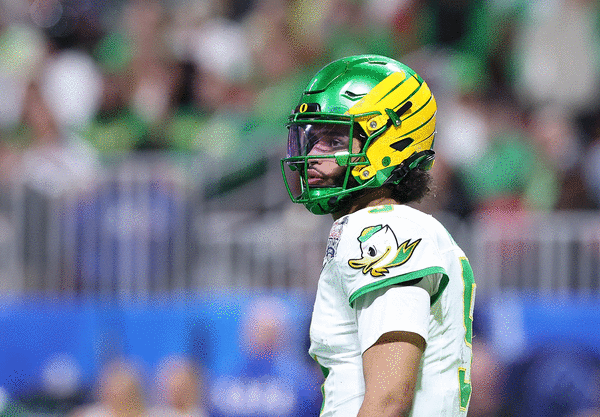
Take the curious case of Dante Moore, Oregon’s redshirt junior quarterback.
He was, by all accounts, one of the nation’s top signal-callers this past season. Moore started all 15 games, completed nearly 72% of his passes, tossed 30 touchdowns against 10 interceptions and led his Ducks to the College Football Playoff semifinals.
Pundits suggested he could have been the second overall pick in the upcoming draft behind Indiana quarterback and Heisman Trophy winner Fernando Mendoza. Based on contract projections, Moore would have been in line for a signing bonus of around $34 million.
“If you’re projected to be the No. 2 overall pick, I mean, let’s get this train rolling,” JJ Watt said a couple months back on “The Pat McAfee Show.”
And yet, the train carrying the 20-year-old is staying put for another year in Eugene, Ore.
Moore, who started his college career at UCLA, opted for another season of development — but it’s not as if he has no insurance policy.
His name, image and likeness (NIL) valuation ballooned from $640,000 to $3 million by the season’s end, and that could continue to rise.
He’s gambling on his draft stock in a 2027 class that is slated to include names like Arch Manning, Julian Sayin and LaNorris Sellers. With the guarantee of a healthy payday in college, it’s a gamble more and more players are willing to take in an attempt to prolong their future careers.
“They’re thinking bigger is better all the time,” former Pittsburgh Steelers’ scout Mark Gorscak told the Pittsburgh Post-Gazette, “and that’s not necessarily true.”
Follow the money
When Sammy Spina was a law student at St. Thomas University nearly a decade ago, he wrote an essay outlining why college football players should not only be paid, but treated as de facto employees at their respective institutions.
“To me, it was about fairness,” said Spina, a NFL agent.
The professor gave Spina a C on the paper because the notion wasn’t “feasible.” Maybe that deserves a revision.
Penn State quarterback Drew Allar, regarded as a potential first-round draft choice in last year’s class, decided to stick around for another year. He suffered a season-ending ankle injury in October and has dropped to a projected late Day 2 to Day 3 prospect.
Allar gambled and seemingly lost. And yet, due to deals with Nike, Venmo, EA Sports and Bose, among others, he still earned an estimated $3.2 million.
Another Nittany Lion, running back Nick Singleton, was highly-thought of in 2025 draft circles but returned for his senior season. He ceded carries to Kaytron Allen, and the production from his 1,099-yard campaign in 2024 was nearly cut in half.
Then, Singleton broke his foot at the Senior Bowl. Like Allar, he’s now viewed as a Day 2 or Day 3 pick.
But, like Allar, Singleton got paid — as of early 2025, his NIL valuation was $1.8 million and included deals with companies such as Gatorade, Fanatics and Dunkin’ Donuts.
This has provided another layer of complexity to NFL draft evaluators.
In early 2024, roughly a year before quarterback Carson Beck transferred from Georgia to Miami (Fla.) and received an NIL deal reportedly worth over $4 million, he purchased a Lamborghini Urus Performante.
Photos of Beck with the car, valued close to $300,000, drew national headlines.
To some, this was just a college kid having fun and capitalizing on his newfound wealth. To others, this was a shaming indictment of the current college athletics landscape and a system spiraling out of control.
Beck signed deals with Powerade, Chipotle and Beats by Dre. He dated a social media influencer. In some ways, the 6-foot-4 quarterback became a poster child for what the House v. NCAA settlement brought to college football.
He’s widely regarded as one of the five best quarterbacks in the upcoming draft. The question NFL teams have grappled with lately — certainly not only in Beck’s case — is how much do players’ financial decisions actually matter in a scouting evaluation.
And should they?
“We don’t penalize a player because he received X amount of dollars in NIL,” said Houston Texans general manager Nick Caserio at the NFL combine. “What’s the rationale? What’s the understanding? Our job is to understand it, not to pass judgment. …
“Now, what are they all doing with that money? That’s another way to look at it. Does the guy have eight cars or does he actually have a financial advisor, and he puts it into an S&P stock index because he’s trying to grow his portfolio?”
According to Front Office Sports, college athletic departments have found ways to skirt the $20.5 million salary cap — which was outlined in the settlement — by procuring NIL guarantees for players in sponsorship contracts.
Often, at deep-pocketed athletic departments around the country, there’s a relatively direct pay-for-play system.
For instance, anchored by a projected $5 million deal for transfer quarterback Sam Leavitt, LSU has reportedly exceeded $40 million on its roster for the 2026 season.
Buffalo Bills general manager Brandon Beane stressed the importance of deciphering whether a prospect is “simply motivated just for money” or if “the money is a side benefit.”
This can become tricky as the price tags grow.
Prior to widespread compensation for college football players, NFL teams and scouts probed prospects about how they would spend the millions of dollars that comes with an NFL paycheck. It was a test to gauge maturity.
Well, they no longer have to speculate.
“We have an opportunity to see how these guys react when they have some money in their hands and how they’re going to respond,” said San Francisco 49ers general manager John Lynch. “So, that’s one positive way to look at that whole situation.”
Rolling the dice
Before deciding whether to enter the draft or stay in school, there’s the growing inevitability of the transfer portal.
That, Gorscak said, is a gamble of its own.
“You roll the dice when you jump in,” he said.
Reasons for transferring can most often be clumped into three categories — seeking more money, more playing time or more exposure at a higher level.
After the transfer window closed Jan. 16, the NCAA reported over 10,500 college football players had entered the portal. One of them, 24-year-old quarterback TJ Finley, prepared to sign with his seventh school in as many years but decided to enter the NFL draft instead.
There are pitfalls to portaling, like in the case of offensive lineman Ethan Onianwa. The hulking 6-foot-7, 331-pound senior played a strong three years at Rice and, after the 2024 season, was projected as at least a third-round pick.
He transferred to Ohio State, jumping from the American Athletic Conference to the Big Ten. Onianwa was kicked inside to guard, struggled in preseason camp and was hampered by injuries throughout the season.
He’s now estimated to be selected in the final rounds or picked up as an undrafted free agent.
But then there’s Mendoza, the likely top selection in this draft. He was a solid quarterback at Cal, productive and flashing potential but not without questions. Mendoza joined coach Curt Cignetti at Indiana, led the Hoosiers to an undefeated national championship and ran away with the Heisman Trophy, as well as just about every quarterback and offensive award.
When evaluating NFL draft prospects who transferred to another school — or two, or three or four — scouts are trying to learn primarily about two areas: system and character fits.
One might expect, for instance, a quarterback who played in three different distinct college offenses to complicate an evaluation. But take, say, the Tennessee Titans’ young quarterback Cam Ward.
In four years, he played for Incarnate Word, Washington State and Miami. He thrived at each spot despite the obvious leap in competition and blossomed into the No. 1 draft choice last year.
“I feel like I have to whisper it, but I’ve kind of enjoyed it,” former scout and NFL Network lead draft analyst Daniel Jeremiah said of the transfer portal. “I’ve had a chance to see guys in different systems. I’ve got a chance to see some lower-level competition guys move up in competition so I’m not having to make as big of a projection. … I think it makes it a little easier to see what you got there.
“I think, in some ways, it’s made scouting easier.”
The human element
The character side is, naturally, more complex.
Before the transient days of college football, scouts could call up any number of sources — teammates, teachers, a head coach, equipment staff, strength coaches — and receive a detailed report.
And they’ll unearth anything they deem valuable to understanding character.
In 2001, when North Allegheny product and Rutgers quarterback Mike McMahon went through the pre-draft process, scouts broached the subject of the time he dyed his hair blonde the summer before his senior year.
They saw it as a potential indicator of a “wild child” which the Detroit Lions’ fifth-round draft choice now laughs at 25 years later.
“They’re trying to do the research and trying to get as much info as possible about players because they’re investing a ton of money,” McMahon said. “That’s what you are. You’re an investment. They’re going to pay you because they’re hoping to get a return on that investment, so they got to do their homework.”
As nonsensical as some evaluations can be, with a player who attended three or more colleges it becomes tougher to dig below the surface.
“You still have established sources, there’s no question about that,” Gorscak said. “But do they really know the guy? You only had him for a one-year rental. Less than a year basically, you had him for the football season only. How do you really know?”
We’re still a few years away, Jeremiah said on a pre-NFL combine conference call, to make any declarations on the correlation between the transfer portal and NFL success.
The most tangible effect, thus far, has been the size of the prospect pool. Kansas City Chiefs general manager Brett Veach said more than 25 players who would have been on the team’s top 100 draft list decided to return to school.
For slam-dunk first-round picks, an NFL signing bonus — which can range from around $10 to $40 million — still far exceeds even a top of the line deal in college.
“At least for the time being,” Spina said. “I’m not saying colleges can’t get there, but at least for the time being, that signing bonus is going to trump anything.”
But some — such as Moore, Allar and Singleton, among others — see another year of development as equally valuable.
And for mid-round draft prospects, another year in school can be more lucrative. As such, the 24-year-old coming off his fifth or sixth collegiate season is no longer a novelty.
Regardless, today’s scouts are still combing through wingspans and vertical leaps and crunching hours upon hours of tape like always.
As for the oft-derided “wild west” transfer portal and sports cars and seven-figure college deals, the only choice for scouting departments is to adapt.
“You have to change,” Gorscak said. “You have to realize that’s what life’s about.”
____
©2026 PG Publishing Co. Visit at post-gazette.com. Distributed by Tribune Content Agency, LLC.




Comments