Fantasy football Week 5: Start, sit and sleepers
Published in Football
Here's a look back at Week 4's action and fantasy advice for the week ahead:
WEEK 4 RECAP
Browns 27, Steelers 24: Deshaun Watson threw for 268 yards and Harold Fannin Jr. caught another touchdown as Cleveland survived Aaron Rodgers’ 299-yard, three-TD performance, but the Browns’ five sacks and two interceptions reinforced why their defense deserves weekly streaming consideration.
Colts 30, Commanders 13: Jonathan Taylor’s 95 rushing yards and two TDs carried Indianapolis through another uneven Daniel Jones performance, while Marcus Mariota’s early knee injury forced Washington to turn to rookie Athan Kaliakmanis and further complicated the fantasy outlook for the Commanders’ pass catchers.
Patriots 29, Bills 26: Drake Maye rebounded from his Week 3 disaster with 269 passing yards, three TDs and 54 rushing yards, Romeo Doubs caught two scores and Keon Coleman’s 116 receiving yards provided an encouraging development for Buffalo’s increasingly crowded receiving corps.
Bears 23, Jets 12: Kyle Monangai erupted for 146 rushing yards and two TDs on 30 carries, Tyson Bagent threw for 268 yards and Rome Odunze added six catches for 94 yards, making Chicago’s backfield hierarchy considerably more interesting after D’Andre Swift was benched following a fumble.
Jaguars 22, Bengals 17: Joe Burrow threw for 428 yards and Tee Higgins caught 11 passes for 157, but Ja’Marr Chase suffered a concussion and Higgins injured his adductor, potentially creating a massive target vacuum in Cincinnati’s passing offense.
Giants 36, Cardinals 24: Jameis Winston threw three TD passes, Malik Nabers finally broke out with six catches for 112 yards and a score, and rookie Malachi Fields caught his first NFL TD, but Winston’s two interceptions and four sacks offered the usual reminder that his fantasy ceiling comes with considerable volatility.
Rams 24, Eagles 20: Kyren Williams scored twice in the fourth quarter to complete Los Angeles’ comeback, while Philadelphia lost Saquon Barkley to a hamstring injury after just two carries and failed to convert any of its 12 third downs, creating another potential opportunity for Will Shipley.
Packers 17, Buccaneers 14: Jordan Love survived another uneven Green Bay offensive performance with help from Tucker Kraft’s TD, while rookie Jalon Daniels rushed for 55 yards but couldn’t overcome two interceptions and three sacks, making Tampa Bay’s diminished passing ceiling a growing concern.
Ravens 24, Titans 18: Lamar Jackson threw for 222 yards and two TDs before leaving with an ankle injury, Zay Flowers delivered 118 receiving yards and a score, and Tennessee rookie Carnell Tate erupted for nine catches and 145 yards despite another inconsistent Cam Ward performance.
Cowboys 34, Texans 30: CeeDee Lamb produced a ridiculous 17 catches for 189 yards and the winning TD, Javonte Williams scored three times and Nico Collins celebrated his return with seven catches for 118 yards and two TDs, turning this into the kind of fantasy bonanza that makes defensive coordinators consider another line of work.
Vikings 15, Dolphins 10: T.J. Hockenson commanded 13 targets for 13 catches and 119 yards with Justin Jefferson sidelined, Aaron Jones added 94 rushing yards and Minnesota’s defense suffocated Miami, while Ollie Gordon’s 100 rushing yards and TD provided the Dolphins a rare reason for fantasy optimism.
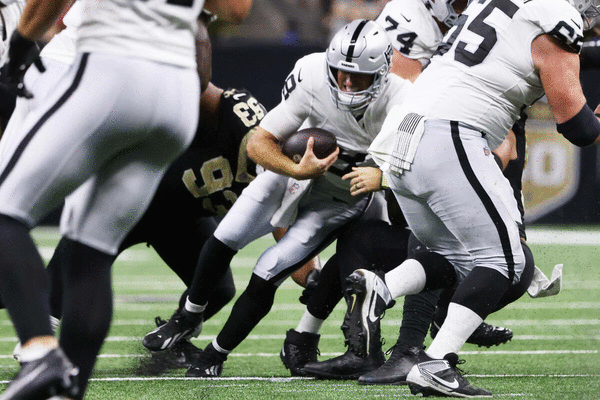
Chiefs 30, Raiders 27: Kenneth Walker III continued his takeover of Kansas City’s backfield with 177 rushing yards and two TDs, including a 76-yard explosion, while Rashee Rice’s hamstring injury and Tyquan Thornton’s serious ankle injury could reshape Patrick Mahomes’ receiving hierarchy after the bye.
49ers 24, Broncos 14: George Kittle delivered a 56-yard TD, Mike Evans returned to contribute five catches for 76 yards and R.J. Harvey caught 10 passes for 68 yards, further establishing the rookie’s PPR utility even when Denver struggles to generate rushing production.
Seahawks 30, Chargers 23: Emanuel Wilson turned his expanded workload into more than 100 scrimmage yards and two TDs, while Justin Herbert threw two first-half interceptions before rallying late and Keaton Mitchell continued making his case for more work in the Chargers’ unsettled backfield.
Panthers 32, Lions 26: Tetairoa McMillan announced himself as a legitimate fantasy superstar with 16 catches for 192 yards and two TDs, Bryce Young repeatedly exploited Detroit’s secondary and Chuba Hubbard scored twice, reinforcing how vulnerable the Lions have become against balanced offenses.
Falcons 45, Saints 24: Bijan Robinson rushed for 145 yards and two TDs, Brian Robinson Jr. added three rushing scores and Michael Penix Jr. efficiently directed Atlanta’s demolition of New Orleans, while Tyler Shough needed 48 pass attempts to produce 286 yards and one late TD.
This week’s guide breaks down 219 players and defenses across all 15 matchups, separating the obvious starters from the difficult decisions, risky plays and sleepers worth considering. Hit me up @UTEddieBrown on X, formerly known as Twitter, with any specific lineup questions I don’t cover below.
Here are my best bets for Week 5:
TAMPA BAY AT DALLAS
Obvious starters: Bucky Irving (TB), Dak Prescott (DAL), CeeDee Lamb (DAL), George Pickens (DAL), Javonte Williams (DAL).
Who to start: Emeka Egbuka (TB) remains Tampa Bay’s most trustworthy receiver because his 20.2% target share and 24.6% first-read share provide a foundation even with Jalon Daniels replacing Baker Mayfield. Kenny Gainwell (TB) offers PPR flex appeal in a matchup where Tampa Bay could be chasing points. Jake Ferguson (DAL) remains a borderline TE1 in an offense producing abundant scoring opportunities, particularly with Tampa Bay missing safety Antoine Winfield Jr.
Who to sit: Jalon Daniels (TB) showed some scrambling ability with 55 rushing yards in his debut, but two interceptions and three sacks against Green Bay make him a Superflex-only option despite Dallas’ vulnerable secondary. Chris Godwin (TB) has become difficult to trust without Mayfield because diminished downfield accuracy further limits his already inconsistent target quality. Cade Otton (TB) could benefit from short throws designed to protect Daniels, but his modest target ceiling makes him a TD-dependent streamer. Ted Hurst III (TB) has averaged 16 yards per reception through four games, but eight catches aren’t enough to justify chasing his big-play potential with a rookie quarterback. The Buccaneers D/ST will be without Winfield and cornerback Benjamin Morrison against Prescott and an offense that just produced 34 points against Houston.
Sleeper: The Cowboys D/ST gets an undrafted rookie making his second career start after throwing two interceptions and taking three sacks against Green Bay, creating a rare streaming opportunity for an otherwise unreliable unit.
PHILADELPHIA VS. JACKSONVILLE AT LONDON
Obvious starters: Trevor Lawrence (JAC), Parker Washington (JAC), Bhayshul Tuten (JAC).
Who to start: Jalen Hurts (PHI) has lost some of his former rushing ceiling, but Philadelphia’s depleted backfield could force him to shoulder more of the offense near the goal line. Dontayvion Wicks (PHI) remains the safest Eagles receiver to trust with DeVonta Smith still sidelined by a hamstring injury and Philadelphia needing reliable separation against Jacksonville’s aggressive secondary. Makai Lemon (PHI) has deeper-league flex appeal because Smith’s absence has created additional routes for the rookie in an offense desperate for dependable receiving production. Jakobi Meyers (JAC) remains a viable WR3 in PPR formats because his intermediate route-running gives Lawrence a dependable alternative when Jacksonville’s outside receivers draw heavier coverage. The Jaguars D/ST has eight takeaways through four games and faces an Eagles offense allowing one of the league’s highest pressure and sack rates.
Who to sit: Saquon Barkley (PHI) is considered week-to-week with a hamstring injury and didn’t practice Wednesday, making him unlikely to play in London. DeVonta Smith (PHI) missed another practice Wednesday with his lingering hamstring injury and remains too uncertain to pencil into a lineup with an early kickoff. Dallas Goedert (PHI) returned to limited practice Wednesday, but his knee injury and uncertain snap count make him a risky play even if he’s cleared. Zach Ertz (PHI) hasn’t commanded enough targets to justify starting him simply because Philadelphia’s receiving corps is shorthanded. Darius Cooper (PHI) caught both of Hurts’ TD passes against the Rams, but two red-zone conversions aren’t enough to establish the consistent target volume necessary to trust him in your lineup. The Eagles D/ST has averaged just 2.8 fantasy points per game and now faces a Jacksonville offense that has protected Lawrence well enough to generate explosive plays. Brian Thomas Jr. (JAC) caught a TD against Cincinnati but remains behind Washington and Meyers in an increasingly crowded target hierarchy. Brenton Strange (JAC) erupted for seven catches and 95 yards against the tight-end-friendly Bengals, but Philadelphia presents a considerably tougher matchup and Strange had only seven catches combined in his previous three games. Chris Rodriguez Jr. (JAC) scored against Cincinnati but remains a TD-dependent complement to Tuten, who handled 17 carries for 73 yards in the victory.
Sleeper: Will Shipley Jr. (PHI) could inherit lead-back duties with Barkley unlikely to play and Tank Bigsby on injured reserve, giving him RB2/flex potential despite Dameon Pierce’s expected involvement.
CHICAGO AT GREEN BAY
Obvious starters: D’Andre Swift (CHI), Christian Watson (GB), Tucker Kraft (GB).
Who to start: Luther Burden III (CHI) has developed into a featured piece of Ben Johnson’s passing game and retains WR2/3 value because his manufactured touches can survive Chicago’s quarterback instability. Rome Odunze (CHI) caught six passes for 94 yards against the Jets and remains a useful WR3/flex with enough downfield opportunity to offset the offense’s occasional inconsistency. Colston Loveland (CHI) continues gaining receiving involvement after producing 57 yards against New York, giving him a reasonable path to low-end TE1 production against Green Bay. Kyle Monangai (CHI) erupted for 146 rushing yards and two TDs on 30 carries against the Jets and could maintain RB2 value against a Packers defense allowing 113.8 rushing yards per game to running backs, provided his thumb injury doesn’t interfere. Jordan Love (GB) has thrown two TD passes in every game this season and still offers streaming appeal with Watson, Kraft and Matthew Golden capable of creating explosive gains despite Chicago’s improved defense. Matthew Golden (GB) remains a high-upside WR3/flex because his ability to win vertically creates opportunities for chunk plays against a Bears defense likely to devote considerable attention to Watson and Kraft.
Who to sit: Tyson Bagent (CHI) completed 25 of 34 passes for 268 yards against the Jets, but Green Bay’s pass rush presents a more difficult challenge for a quarterback still learning to avoid costly mistakes. Kalif Raymond (CHI) has flashed genuine big-play ability, but Burden, Odunze and Loveland are competing for enough targets to make his weekly volume difficult to predict. The Bears D/ST has averaged almost nine fantasy points over its last three games, but Love’s ability to distribute the ball quickly and exploit aggressive pressure packages makes this a tougher matchup than Chicago’s recent opponents. MarShawn Lloyd (GB) remains trapped in a crowded backfield without enough consistent early-down or receiving work to earn a fantasy start.
Sleeper: The Packers D/ST has an opportunity to capitalize on Chicago’s quarterback uncertainty and a potentially compromised backfield, particularly if injuries along the Bears’ offensive line force Bagent to operate under pressure.
HOUSTON AT TENNESSEE
Obvious starters: Nico Collins (HOU).
Who to start: David Montgomery (HOU) has been painfully inefficient since his three-TD opener, but Tennessee’s winless defense provides an opportunity for Houston to establish the run and restore his goal-line scoring chances. The Texans D/ST gets an offense that has struggled to protect Cam Ward and finish red-zone drives, creating multiple paths to sacks and takeaways despite Houston’s own disappointing start. Carnell Tate (TEN) has graduated into trustworthy WR3 territory after commanding nine catches for 145 yards against Baltimore and now faces a Houston secondary that has repeatedly surrendered explosive receiver performances. Wan’Dale Robinson (TEN) offers a useful PPR floor because his short-area role creates easy completions for Ward when Tennessee’s protection breaks down. Tony Pollard (TEN) has a legitimate RB2 workload after dominating the Titans’ backfield touches, although his absence from Wednesday’s practice makes his health worth monitoring.
Who to sit: C.J. Stroud (HOU) rebounded with 347 yards and two TDs against Dallas, but Tennessee’s defense has been considerably tougher against the pass than its winless record suggests, keeping him outside my preferred one-QB options. Dalton Schultz (HOU) loses considerable target upside with Collins back and faces a Titans defense allowing the third-fewest receiving yards to tight ends. Kayshon Boutte (HOU) remains a low-volume perimeter option who needs an explosive catch or TD to matter with Collins back atop the receiving hierarchy. Cam Ward (TEN) managed 222 yards and a TD against Baltimore but continues to surrender too many high-value possessions through turnovers and poor red-zone execution. Calvin Ridley (TEN) has fallen behind Tate and Robinson for dependable opportunities, leaving him reliant on a low-percentage deep connection. Tyjae Spears (TEN) hasn’t carved out enough touches behind Pollard to justify using him while the starter is healthy. Gunnar Helm (TEN) offers occasional underneath involvement but lacks the routes and red-zone priority needed for consistent TE1 production. The Titans D/ST doesn’t offer enough sack or turnover upside to overcome Houston’s restored passing-game firepower with Collins healthy.
Sleeper: Woody Marks (HOU) scored against Dallas and offers PPR flex appeal because his receiving ability provides a more efficient complement to Montgomery than Houston’s struggling traditional rushing attack.
CINCINNATI AT MIAMI
Obvious starters: Joe Burrow (CIN), Chase Brown (CIN).
Who to start: Ja’Marr Chase (CIN) remains an automatic WR1 if he clears the concussion protocol because Miami lacks the coverage talent to contain his route-running and explosive-play ability. Tee Higgins (CIN) caught 11 passes for 157 yards against Jacksonville and would carry WR1 upside if his adductor injury allows him to play, especially if Chase remains sidelined. The Bengals D/ST ranks fourth in the NFL with an 8.59% sack rate and faces a Miami offense that hasn’t scored more than 13 points in any game this season. Malik Washington (MIA) remains a viable PPR flex because Miami’s depleted receiving corps and lack of explosiveness elsewhere have created a steady supply of short-area opportunities.
Who to sit: Dohnte Meyers (CIN) could see additional opportunities if Chase and Higgins are sidelined, but his uncertain role and small sample size of success make him a speculative flex rather than a trustworthy starter. Malik Willis (MIA) has struggled to generate consistent passing production and faces a Cincinnati defense capable of creating pressure without sacrificing coverage. Caleb Douglas (MIA) missed Wednesday’s practice with his ankle injury and remains too risky to trust in an already limited passing offense. Chris Bell (MIA) possesses intriguing big-play ability, but Miami’s quarterback situation hasn’t produced enough catchable downfield opportunities to support him. Ollie Gordon (MIA) erupted for 100 rushing yards and a TD on nine carries against Minnesota, but that explosive performance doesn’t erase his uncertain receiving involvement against an underrated Bengals run defense. Jaylen Wright (MIA) remains the lesser fantasy option behind Gordon until Miami demonstrates a willingness to give him meaningful early-down or goal-line work. The Dolphins D/ST faces Burrow and a Cincinnati offense capable of exploiting Miami’s secondary even if one or both of its starting receivers can’t play.
Sleeper(s): Mike Gesicki (CIN) has scored a TD and topped 12 PPR points in three of four games, and Miami just surrendered 13 catches for 119 yards to T.J. Hockenson. Greg Dulcich (MIA) offers desperation-streaming appeal because Miami’s thin receiving corps could push additional short-area targets toward its athletic tight end, particularly if Douglas remains unavailable.
LAS VEGAS AT NEW ENGLAND
Obvious starters: Brock Bowers (LV), Ashton Jeanty (LV), Drake Maye (NE).
Who to start: TreVeyon Henderson (NE) remains a volatile RB2/flex because his explosive rushing ability gives him more upside than his recent production suggests, particularly if New England can establish positive game script at home. Romeo Doubs (NE) caught two TD passes against Buffalo and has become Maye’s most dependable downfield target, giving him legitimate WR2/3 value against a Raiders secondary vulnerable to aggressive passing attacks. Hunter Henry (NE) remains a borderline TE1 because Maye’s improved efficiency should create enough middle-of-the-field and red-zone opportunities to compensate for the weekly target competition. The Patriots D/ST gets a stationary Kirk Cousins behind an offensive line that struggled against Kansas City’s four-man pressure, creating an attractive sack ceiling even with Christian Gonzalez’s status uncertain.
Who to sit: Kirk Cousins (LV) has delivered multiple TD passes in every game this season, but New England’s ability to generate pressure and disguise coverage makes this a difficult spot to chase another QB1 performance. Mike Washington Jr. (LV) remains premium insurance for Jeanty rather than a standalone flex while the Raiders’ first-round investment dominates the valuable backfield touches. Michael Mayer (LV) has TD-dependent appeal in two-tight-end formations, but Bowers’ return significantly limits the routes and first-read opportunities available to him. Rhamondre Stevenson (NE) scored against Buffalo but continues to share enough work with Henderson that his declining explosiveness makes him a risky flex in a potentially low-scoring matchup. DeMario Douglas (NE) has become a secondary option behind Doubs and Henry, leaving too few high-value targets to justify starting him outside deeper PPR formats.
Sleeper(s): Tre Tucker (LV) offers boom-or-bust flex appeal because Cousins continues attacking downfield and Bowers’ presence can pull coverage away from the Raiders’ primary vertical threat. The Raiders D/ST could outperform expectations if New England’s offensive line struggles as it did against Buffalo, especially with Maye still occasionally holding the ball too long while searching for explosive plays.
MINNESOTA AT NEW ORLEANS
Obvious starters: Justin Jefferson (MIN), Aaron Jones (MIN), Vikings D/ST, Chris Olave (NO), Juwan Johnson (NO).
Who to start: T.J. Hockenson (MIN) caught 13 passes for 119 yards against Miami and remains a strong TE1 because Kyler Murray increasingly relies on him as his most dependable short-area target. Devaughn Vele (NO) maintains WR3/flex appeal because his intermediate routes and red-zone involvement offer a useful complement to Olave in an offense frequently forced into pass-heavy game scripts.
Who to sit: Kyler Murray (MIN) has produced just one TD pass, two interceptions and 42 rushing yards through four games, making him difficult to trust even against a New Orleans defense that surrendered 45 points Monday night. Jordan Addison (MIN) missed Wednesday’s practice and remains a risky flex because his inconsistent target volume has become even harder to predict alongside Jefferson and Hockenson. Jauan Jennings (MIN) hasn’t converted Jefferson’s recent absence into consistent fantasy production and could lose even more opportunities with Minnesota’s No. 1 receiver returning. Tyler Shough (NO) needed 48 attempts to reach 286 passing yards against Atlanta and now faces a Brian Flores defense capable of disguising pressure and forcing hurried decisions. Alvin Kamara (NO) scored twice against Atlanta but remains a low-ceiling flex against a Minnesota front capable of overwhelming a Saints rushing attack that managed only 50 yards last week. Kendre Miller (NO) remains behind Kamara for valuable touches and lacks the receiving involvement necessary to survive a difficult rushing matchup.
Sleeper: The Saints D/ST has deep-league streaming appeal because Murray has yet to produce a reliable passing or rushing ceiling and Minnesota’s offense has struggled to turn sustained drives into touchdowns.
CLEVELAND AT N.Y. JETS
Obvious starters: Quinshon Judkins (CLE), Harold Fannin Jr. (CLE), Garrett Wilson (NYJ).
Who to start: Denzel Boston (CLE) continues earning valuable perimeter opportunities and offers WR3/flex appeal against a Jets secondary that has struggled to contain downfield passing. KC Concepcion (CLE) has yet to turn his encouraging target volume into consistent efficiency, but his involvement on designed touches gives him a reasonable PPR floor against New York. Braelon Allen (NYJ) should handle lead-back duties again if Breece Hall’s thigh injury keeps him sidelined, giving him enough rushing and goal-line volume to maintain RB2 value. Kenyon Sadiq (NYJ) offers low-end TE1 appeal against a Cleveland defense capable of forcing quarterbacks to throw underneath.
Who to sit: Deshaun Watson (CLE) threw for 268 yards against Pittsburgh but remains a volatile fantasy option whose limited rushing production makes him overly dependent on passing TDs. Jerry Jeudy (CLE) continues losing the most valuable receiving opportunities to Boston, Concepcion and Fannin, leaving him without a dependable weekly ceiling. The Browns D/ST is coming off five sacks and two interceptions against Pittsburgh, but injuries along Cleveland’s defensive front could reduce its pressure rate against a Jets offense likely to emphasize quick throws and the running game. Breece Hall (NYJ) missed Wednesday’s practice with his lingering thigh injury and shouldn’t be used unless he’s cleared for a meaningful workload. Adonai Mitchell (NYJ) also missed Wednesday’s practice and remains too inconsistent to trust even if his finger injury allows him to return. The Jets D/ST faces a Cleveland offense that has won three straight games and increasingly benefits from Watson distributing the ball to multiple legitimate receiving threats.
Sleeper: Geno Smith (NYJ) deserves consideration as a deeper Superflex streamer because Wilson and Sadiq give him dependable targets against a Cleveland defense dealing with injuries up front, although his 119-yard performance against Chicago illustrates the downside.
INDIANAPOLIS AT PITTSBURGH
Obvious starters: Jonathan Taylor (IND), Tyler Warren (IND), Jaylen Warren (PIT).
Who to start: Josh Downs (IND) remains a useful PPR WR3/flex because his short-area role should command additional opportunities if Keenan Allen’s groin injury continues limiting his availability. Aaron Rodgers (PIT) has thrown for at least 299 yards in consecutive games and gets a Colts defense missing multiple contributors in its front seven, strengthening his case as a QB1 streamer. DK Metcalf (PIT) caught five passes for 115 yards against Cleveland to demonstrate his continued value as Pittsburgh’s primary vertical threat, particularly with Rodgers finally attacking downfield effectively. The Steelers D/ST gets Daniel Jones coming off a 143-yard passing performance that included two early turnovers, creating an attractive sack-and-takeaway matchup at home.
Who to sit: Daniel Jones (IND) has struggled to generate explosive passing plays and now faces a Pittsburgh defense capable of overwhelming an offensive line that could be without starting center Tanor Bortolini. Keenan Allen (IND) remains difficult to trust while nursing his groin injury and competing with Downs and Warren for the intermediate targets that once made him a PPR staple. Michael Pittman Jr. (PIT) was limited Wednesday with a foot injury and hasn’t established enough consistent volume behind Metcalf to justify starting him outside deeper PPR leagues. Rico Dowdle (PIT) returned to limited practice Wednesday after missing two games with a dislocated toe, but Warren’s emergence makes Dowdle a risky flex even if he’s cleared. Pat Freiermuth (PIT) remains TD-dependent because Rodgers increasingly funnels his most valuable targets toward Metcalf and the running backs. Darnell Washington (PIT) offers occasional red-zone appeal, but his limited receiving workload makes him difficult to trust unless Pittsburgh specifically designs opportunities for its enormous tight end.
Sleeper(s): The Colts D/ST has deeper-league streaming appeal because Rodgers took five sacks and threw two interceptions against Cleveland, although Indianapolis will need its depleted pass rush to generate pressure without sending extra defenders. Roman Wilson (PIT) could benefit from increased opportunities if Pittman’s foot injury limits him, giving the young receiver a path to a usable flex score against an injury-depleted Indianapolis secondary.
N.Y. GIANTS AT WASHINGTON
Obvious starters: Isaiah Likely (NYG), Jayden Daniels (WAS).
Who to start: Malik Nabers (NYG) becomes an obvious WR1 if his sore knee allows him to play after he finally established a productive connection with Winston for six catches, 112 yards and a TD against Arizona. Cam Skattebo (NYG) belongs in the obvious-starter category if his shoulder injury doesn’t compromise his workload because his physical running style and receiving involvement give him multiple routes to RB1 production. Stefon Diggs (WAS) remains a WR3/flex if his hamstring injury allows him to play, with Daniels’ expected return offering better target quality than Washington’s backup quarterbacks provided last week. Jacory Croskey-Merritt (WAS) is a TD-dependent RB2/flex whose prospects improve with Daniels returning to restore Washington’s read-option threat and create additional scoring opportunities. Chig Okonkwo (WAS) could receive additional short-area targets if Washington’s injured receivers remain unavailable, giving him low-end TE1 potential despite his own hamstring issue.
Who to sit: Najee Harris (NYG) remains a complementary back behind Skattebo and needs either an injury-driven workload increase or a short-yardage TD to produce a usable fantasy score. The Giants D/ST faces a considerably more difficult assignment with Daniels returning after Washington’s offense struggled through two backup quarterbacks against Indianapolis. Terry McLaurin (WAS) missed Wednesday’s practice with his hamstring injury and remains too uncertain to trust until his availability and expected workload become clearer. Rachaad White (WAS) returned to limited practice Wednesday after dealing with a shoulder injury, but Washington’s crowded backfield makes his touch projection too volatile for a comfortable start. Austin Ekeler (WAS) led Washington’s backfield in rushing yards against Indianapolis but remains trapped in a committee that hasn’t generated enough scoring opportunities to support multiple fantasy starters.
Sleeper(s): Jameis Winston (NYG) has QB1 streaming upside against a Washington defense allowing more than 23 fantasy points per game to quarterbacks, with the usual warning that his three-TD ceiling comes attached to multiple-turnover risk. Malachi Fields (NYG) caught his first NFL TD against Arizona and offers deep-league flex appeal if Nabers’ knee injury creates a larger role for the rookie. Antonio Williams (WAS) could inherit meaningful targets if Diggs and McLaurin remain sidelined, giving him PPR sleeper potential in a passing attack upgraded by Daniels’ return. The Commanders D/ST gets Winston coming off a three-TD performance that also included two interceptions and four sacks, creating an obvious path to fantasy production if Washington’s pass rush can force aggressive decisions.
DENVER AT L.A. CHARGERS
Obvious starters: Jaylen Waddle (DEN).
Who to start: J.K. Dobbins (DEN) retains RB2/flex appeal against a Chargers defense that allowed Seattle’s backs to generate consistent rushing production, although Denver’s preference for rotating its backfield limits his weekly ceiling. R.J. Harvey (DEN) caught 10 passes for 68 yards against San Francisco and has become a legitimate PPR flex because his receiving workload offers dependable value even when Denver’s running game stalls. The Broncos D/ST gets an injury-ravaged Chargers offensive line ranked 29th by Pro Football Focus entering Week 5, creating significant sack and turnover upside. Justin Herbert (LAC) remains a risky but viable QB1 streamer because Denver will be missing All-Pro cornerback Patrick Surtain II and could also be without Riley Moss, opening up opportunities for explosive passes. Omarion Hampton (LAC) remains an RB2/flex option because of his talent and a favorable matchup against a surprisingly vulnerable Denver run defense, although Keaton Mitchell’s growing role limits his ceiling. Oronde Gadsden II (LAC) caught five passes against Seattle and could command additional middle-of-the-field targets with McConkey injured and Denver’s secondary missing key contributors.
Who to sit: Bo Nix (DEN) ranks near the bottom of the league in completion rate over expected and has finished as a top-12 fantasy quarterback only once through four games, making him difficult to trust despite the Chargers’ winless start. Courtland Sutton (DEN) has become a secondary option behind Waddle and needs either a TD or an unusually high-volume passing script to provide dependable WR3 production. Evan Engram (DEN) remains difficult to trust because Harvey’s receiving emergence and Denver’s crowded passing-game hierarchy continue limiting his target ceiling. Ladd McConkey (LAC) missed Wednesday’s practice with his foot injury and faces both health and pass-protection concerns even if he’s active against Denver. Quentin Johnston (LAC) was limited Wednesday with a chest injury and remains TD-dependent; inconsistent target share makes him difficult to prioritize. The Chargers D/ST has enough defensive talent to create occasional pressure, but injuries throughout the secondary and Herbert’s offense repeatedly giving opponents favorable field position undermine its fantasy appeal.
Sleeper(s): Tre’ Harris (LAC) could see additional routes and targets if McConkey remains unavailable, and Denver’s depleted cornerback group offers a favorable opportunity for the rookie to create explosive plays. Keaton Mitchell (LAC) has legitimate flex appeal after essentially matching Hampton’s playing time, with his explosive speed and natural fit in Mike McDaniel’s offense creating a realistic path to becoming the preferred back.
DETROIT AT ARIZONA
Obvious starters: Jahmyr Gibbs (DET), Amon-Ra St. Brown (DET), Sam LaPorta (DET), Trey McBride (ARI), Jeremiyah Love (ARI), Michael Wilson (ARI).
Who to start: Jared Goff (DET) ranks among the league leaders with a 108.6 passer rating and 51.1% passing success rate, giving him QB1 upside against a Cardinals defense allowing the fifth-most fantasy points to quarterbacks. Jameson Williams (DET) has an excellent opportunity to exploit Arizona’s vulnerable perimeter coverage, making him a high-ceiling WR2/3 in a matchup with substantial shootout potential. Jacoby Brissett (ARI) is an attractive QB1 streamer against a Lions defense allowing an NFL-high 1,308 passing yards and 11 passing TDs through four games. Tyler Allgeier (ARI) remains TD-dependent behind Love, but Detroit’s defensive struggles and the potential for a high-scoring game give him deeper-league flex appeal.
Who to sit: The Lions D/ST just surrendered 32 points and nearly 450 yards to Carolina and now faces an Arizona offense featuring McBride, Wilson and Love in another potentially explosive matchup. Marvin Harrison Jr. (ARI) remains impossible to trust while Wilson and McBride command most of the high-value targets, leaving the former first-round pick dependent on a low-percentage vertical connection. The Cardinals D/ST faces Goff and an offense featuring multiple matchup-proof playmakers, creating considerably more downside than sack or turnover upside.
Sleeper: Isaac TeSlaa (DET) has deep-league flex appeal because his size and contested-catch ability create opportunities in scoring territory against an Arizona defense that has struggled to cover receivers consistently.
SAN FRANCISCO AT SEATTLE
Obvious starters: Christian McCaffrey (SF), George Kittle (SF), Jaxon Smith-Njigba (SEA).
Who to start: Brock Purdy (SF) has yet to be sacked through four games and remains a strong QB1 because Kyle Shanahan’s offense is creating explosive plays while protecting the ball better than almost anyone in football. Mike Evans (SF) caught five passes for 76 yards against Denver and maintains WR2 value as San Francisco’s primary outside threat, although his rib injury remains worth monitoring. Deebo Samuel (SF) continues benefiting from manufactured touches around the formation and retains WR2/3 value because Shanahan can use him as both a receiver and runner to attack Seattle’s aggressive defensive structure. Emanuel Wilson (SEA) erupted for more than 100 scrimmage yards and two TDs against the Chargers and should maintain RB2/flex value with Zach Charbonnet still unavailable and Seattle continuing to lean on its running game. The Seahawks D/ST remains a high-risk fantasy start against an exceptionally efficient San Francisco offense, but Mike Macdonald’s ability to generate pressure with disguised fronts gives Seattle some potential to disrupt Purdy’s rhythm at home.
Who to sit: Kaelon Black (SF) remains premium McCaffrey insurance rather than a standalone flex while the veteran continues dominating San Francisco’s high-value backfield touches. Sam Darnold (SEA) managed only 168 passing yards against the Chargers and now faces a 49ers defense allowing just 5.9 yards per attempt, the third-lowest mark in the league. Rashid Shaheed (SEA) retains big-play ability but faces a San Francisco defense capable of limiting vertical opportunities and forcing Seattle to sustain long drives. Cooper Kupp (SEA) has become a low-volume option behind Smith-Njigba and Shaheed, leaving too few reliable targets to maintain weekly WR3 value. AJ Barner (SEA) remains a TD-dependent streamer because Seattle’s offense isn’t consistently creating enough tight-end targets behind its featured receivers and running backs.
Sleeper: The 49ers D/ST gets a Seattle offense coming off an uneven passing performance from Darnold and could capitalize on the quarterback’s occasional risky decisions, although a banged-up defensive line might limit San Francisco’s pass-rushing ceiling.
BALTIMORE AT ATLANTA
Obvious starters: Derrick Henry (BAL), Zay Flowers (BAL), Bijan Robinson (ATL), Drake London (ATL).
Who to start: Lamar Jackson (BAL) becomes an obvious QB1 if his injured ankle allows him to play without limitations, although his absence from Wednesday’s practice makes Tyler Huntley a realistic alternative for Baltimore. Mark Andrews (BAL) caught a TD against Tennessee and could receive additional intermediate targets if Huntley starts, giving him a reasonable path to low-end TE1 production. The Ravens D/ST has the potential to generate sacks and takeaways against an Atlanta offense that remains heavily dependent on its running game, although injuries to several Baltimore defenders make this a riskier play than usual.
Who to sit: Rashod Bateman (BAL) remains a low-volume vertical receiver who could see his downfield opportunities shrink considerably if Huntley replaces Jackson. Kyle Pitts (ATL) has become increasingly TD-dependent in an offense built around Bijan Robinson and Drake London, making him difficult to prioritize against Baltimore’s athletic linebacking corps. Brian Robinson Jr. (ATL) scored three rushing TDs against New Orleans, but that type of goal-line production is difficult to repeat while Bijan continues dominating the touches that generate consistent yardage. Zachariah Branch (ATL) possesses game-breaking speed but remains a speculative deep-league play because Atlanta hasn’t established a dependable weekly receiving workload for him. Jahan Dotson (ATL) caught a 31-yard TD against New Orleans but remains a low-volume option whose fantasy production depends on connecting with Penix on occasional deep throws.
Sleeper: Michael Penix Jr. (ATL) deserves streaming consideration against a Baltimore defense potentially missing Marlon Humphrey and several other contributors, particularly if the Falcons can use Robinson’s rushing threat to create opportunities for play-action shots to London and Dotson.
BUFFALO AT L.A. RAMS
Obvious starters: Josh Allen (BUF), James Cook III (BUF), Matthew Stafford (LAR), Puka Nacua (LAR), Davante Adams (LAR), Kyren Williams (LAR).
Who to start: Khalil Shakir (BUF) remains a PPR-friendly WR3/flex because his short-area route-running offers Allen a dependable answer against a Rams defense likely to prioritize eliminating explosive plays. The Bills D/ST has struggled to generate consistent fantasy production, but Stafford’s two interceptions against Philadelphia offer some encouragement for managers willing to chase turnover upside despite the difficult matchup. Tyler Higbee (LAR) has low-end TE1 appeal because Stafford’s high-volume passing attack creates enough intermediate opportunities for him to remain useful behind Nacua and Adams.
Who to sit: DJ Moore (BUF) remains a volatile WR3/flex because Allen’s target distribution is increasingly spread among Buffalo’s receivers and running backs, limiting his dependable weekly target ceiling. Dalton Kincaid (BUF) has seen his target share collapse from 25% in Weeks 1-2 to 8.9% in Weeks 3-4 and now faces a Rams defense that has allowed just 85 total receiving yards to tight ends through four games. Blake Corum (LAR) remains a high-value insurance policy for Williams rather than a player to start alongside him while the veteran continues controlling Los Angeles’ goal-line touches. The Rams D/ST has generated only three takeaways through four games and faces Allen, whose dual-threat ability makes even productive defensive performances difficult to translate into fantasy points.
Sleeper: Keon Coleman (BUF) is coming off 116 receiving yards and a TD against New England and offers high-upside WR3/flex potential because his size and contested-catch ability provide Allen a dangerous option against Los Angeles’ secondary.
BYE: Kansas City, Carolina.
©2026 The San Diego Union-Tribune. Visit sandiegouniontribune.com. Distributed by Tribune Content Agency, LLC.





Comments