Second bird flu case confirmed on Queen Anne's County farm
Published in Health & Fitness
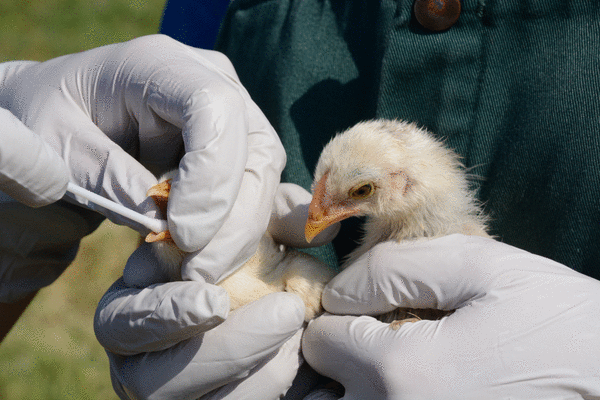
Maryland officials confirmed a second positive test for bird flu at a commercial poultry operation in Queen Anne’s County last week, the 10th detection in the state this year, as public health experts warn the virus continues to pose a serious threat to animals — but remains a low risk for most people.
State health and agriculture officials said the infected birds did not enter the food supply and the outbreak is considered contained. The Centers for Disease Control and Prevention continues to rate the overall public health risk as low, with no evidence of sustained person-to-person spread.
Avian influenza, or bird flu, is a highly contagious airborne respiratory virus that affects poultry, including chickens, ducks and turkeys, along with some wild bird species such as geese, shorebirds and raptors.
Placing the farm on quarantine
Dr. Jennifer Trout, a Maryland Department of Agriculture state veterinarian, told The Sun there was a positive test on Friday at an MDA lab in Salisbury, based on samples from Queen Anne’s County. The site was immediately placed under quarantine and samples were sent to the National Veterinary Services Laboratory in Iowa for confirmation.
MDA is working with the U.S. Department of Agriculture to clean and disinfect the site “following strict biosecurity protocols.”
“The birds were humanely euthanized on Saturday to prevent any further spread of disease. The situation is considered contained,” Trout said. “The virus was most likely introduced by wild birds.”
Trout said bird flu remains an ongoing risk to migratory wild birds in Maryland, especially during colder, wetter months when the virus is more active in the environment.
‘The virus is here’
“This virus is here,” said Meghan Davis, an associate professor in the Department of Environmental Health and Engineering at the Johns Hopkins Bloomberg School of Public Health and a former dairy veterinarian. “It’s been ongoing since 2022, which is highly unusual, and it has been absolutely catastrophic for animal health.”
While most human cases in the U.S. have been mild, Davis said sporadic severe infections — including hospitalizations and deaths — remain a concern, particularly among people with close contact with birds or sick animals.
“So that’s why you hear the CDC saying the risk is low,” Davis said. “That’s low for the general public, not necessarily for people with backyard poultry, those working in poultry or dairy operations, or anyone who has regular contact with wild birds.”
There have been 71 confirmed human cases of bird flu in the United States, including two deaths. The most recent U.S. death involved an H5N5 strain, a form of bird flu distinct from the more common H5N1, and occurred in a person with underlying health conditions who had contact with birds, Davis said.
The Queen Anne’s County case likely involves an H5N1 strain, though confirmatory testing is ongoing.
“If we’re going to see it anywhere in Maryland, it’s going to be on the Eastern Shore,” Davis said, citing the region’s concentration of poultry processing facilities.
Anyone who sees sick or dead birds in the wild should not handle or move the birds, but should report them to the Animal and Plant Health Inspection Service by calling 1-877-463-6497. USDA Wildlife Services operators are available from 8 a.m. to 4:30 p.m. Monday through Friday, except state holidays. Those outside Maryland should call 410-349-8055.
_____
©2025 Baltimore Sun. Visit baltimoresun.com. Distributed by Tribune Content Agency, LLC.









Comments