'Largest outbreak that we've seen in California': Death cap mushrooms linked to deaths, hospitalizations
Published in Health & Fitness
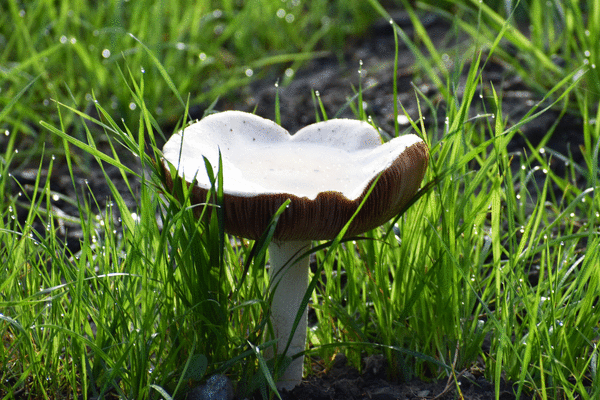
An exceptionally wet December has contributed to an abundance of death cap mushrooms, or Amanita phalloides, on the Central Coast and Northern California, causing what officials describe as an unprecedented outbreak of severe illness and death among people who consume the fungi.
Public health officials are issuing a second warning this winter, this time urging the public against foraging for wild mushrooms, noting that many people have mistakenly eaten the death cap that, when consumed, can cause severe liver damage and in some causes death.
In the last 26 years, "we have not had a season as deadly as this season both in terms of the total numbers of cases as well as deaths and liver transplants," said Craig Smollin, medical director of the San Francisco division of the California Poison Control System.
"I believe this is probably the largest outbreak that we've seen in California, ever."
The California Department of Public health reported 35 death cap-related illness, including three fatalities and three liver transplants between Nov. 18 and Jan. 6. Affected people were between the ages of 19 months old and 67 years old.
In a typical year, the California Poison Control Center may receive up to five cases of poisonous mushroom-related illness, according to authorities.
The last major outbreak of mushroom-related illness in California occurred in 2016 with 14 reported cases and while there were no deaths, three people required liver transplants and one child suffered a "permanent neurologic impairment."
The death cap is the world's most poisonous mushroom, responsible for 90% of mushroom-related fatalities.
Where the death-cap outbreak is concentrated
When state public health officials first warned of the dangers of the death-cap mushroom in December, significant clusters of reported illness occurred in Monterey and the San Francisco bay areas.
Reported hospitalizations have since grown to include Alameda, Contra Costa, Monterey, San Francisco, San Luis Obispo, San Mateo, Santa Clara, Santa Cruz and Sonoma counties.
Death cap mushrooms are known to sprout across the state of California but they thrive in shady, humid or moist environments under live oak and cultivated cork oak trees.
Death cap mushrooms bloom particularly well after the fall and winter rains. Once they sprout, its tall and graceful characteristics are very conspicuous and catch people's eye, said David Campbell, an expert on mushroom consumption or a mycophagist.
Who is mistakenly eating the death cap
People who have accidentally consumed the death cap were usually foraging for mushrooms in the wilderness, either alone or with a group, officials say.
Among the affected are monolingual speakers of Spanish, Chinese, Mandarin and Mixteco as well as foragers who may confuse the death cap mushroom for edible fungi from their native countries, according to experts.
"So they have a false sense of security in their knowledge, thinking they know what they're doing but that only applies to where they're from," Campbell said.
"We're seeing that a number of patients do seem to have a Hispanic background," said Dr. Rita Nguyen, assistant state public health officer at the California Department of Public Health.
In November, a Salinas family said they went on a hike in their community and found the death cap which looked similar to an edible mushroom they would forage for in their hometown in Oaxaca, KSBW Action News reported.
Laura Marcelino and Carlos Diaz took the mushrooms home, cooked them and ate them — their children did not. They both threw up, had diarrhea for an entire day and were later hospitalized, KSBW Action News reported. Marcelino's condition improved but Diaz's health declined exponentially to the point that he fell into a comma and was put on a list to receive a liver transplant, according to news reports.
Why people are mistakenly eating death cap mushrooms
The three most deadly mushrooms in California include the death cap, destroying angel (Amanita ocreata) and deadly Galerina (Galerina marginata), according to the Bay Area Mycological Society.
The death cap mushroom has a dome-shape smooth cap with olive or yellowish-green tones. On the underside of its cap are white gills and spores.
It can be confused with the mushroom species Volvariella, which is edible.
These mushrooms appear similar because they have a volva, a cup-like structure at the base of the mushroom's stem, and are white-ish, but lack one important key characteristic annulus, or ring, around its stem, said Ari Jumpponen, Kansas State University distinguished professor of biology.
Jumpponen said some Volvariella species can be found in Oaxaca.
What symptoms can you expect after eating a death cap?
No amount of death cap is safe to consume.
"I also want to just stress that there's nothing, there's no cooking of the mushroom or freezing of the mushroom that would inactivate the toxin," Smollin said.
The poisonous toxins from the death cap can result in a delayed gastrointestinal symptoms that may not appear until 6 to 24 hours after eating it.
Some of the early symptoms that can go away within a day include nausea, vomiting, diarrhea, abdominal pain, drop in blood pressure, fatigue and confusion.
Mild symptoms may only be the beginning of a more severe reaction.
Severe symptoms can develop within 48 to 96 hours, include progressive liver damage and, in some cases, full liver failure and potentially death, Smollin said.
_____
©2026 Los Angeles Times. Visit latimes.com. Distributed by Tribune Content Agency, LLC.








Comments