Gov. Josh Stein signs executive order following NC killings tied to mental illness
Published in Health & Fitness
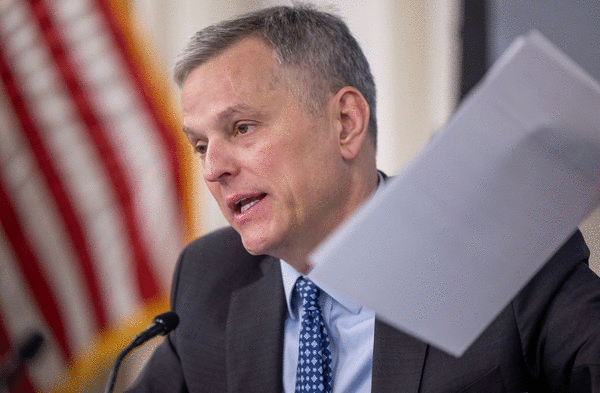
RALEIGH, N.C. — North Carolina Gov. Josh Stein has signed a new executive order directing various state agencies to “take unified action” to strengthen the state’s behavioral health and criminal justice systems.
“Recently, there have been several tragic instances in North Carolina where people experiencing serious mental health crisis have terrible, horrific consequence,” said Stein, pointing to recent killings in Raleigh, Charlotte and Southport.
“The vast majority of people mental health challenges don’t pose any risk,” Stein said during a Thursday morning news conference, but “a small minority of people who are experiencing paranoid delusions can pose a risk to public safety when their serious mental illness goes untreated.”
“Everyone deserves access to care, and these moments have shown us that our system needs to work better, better for the people who are suffering, better for those who are around them, and better for the entire community,” he said.
To inform the executive order, Stein said he had spent the past several months traveling across the state meeting with law enforcement officers and mental health care providers.
Stein said the executive order focuses on three key stages — before arrest, during incarceration and after release. Here’s what the order does, according to Stein:
— Calls for expanding the co-responder model that pairs law enforcement with social workers and mental health professionals to respond to service calls. That could include embedding a social worker at 911 dispatch, strengthening coordination between 911 and the 988 crisis line, and increasing public awareness of 988. The 988 Suicide and Crisis Lifeline connects callers who dial 988 with trained counselors.
— Directs the state Department of Health and Human Services to “consult broadly” and recommend reforms to the involuntary commitment process, which faces rising numbers of petitions and limited treatment beds.
— Requires DHHS and the state Department of Adult Correction to collaborate on standardizing and improving treatment programs in prisons, and directing DHHS and the Department of Public Safety to provide recommendations on creating juvenile-specific mental health crisis units to ensure young people receive appropriate care in youth development centers. Stein said about 40% of incarcerated people report having mental health issues, while roughly 75% report substance use problems. Nearly 98% of youths involved in the criminal justice system have mental health concerns, he said.
— Orders agencies to recommend ways to expand access to health care, housing and job opportunities for people leaving custody.
— Directs the Office of State Human Resources to work with DAC, DHHS and DPS to expand recruitment efforts, improve retention programs, address staffing shortages and make policy recommendations.
Stein said DAC has a vacancy rate of nearly 50% for correctional officers and that starting pay in North Carolina ranks 49th in the country.
Meanwhile, at DHHS, about a quarter of inpatient units — enough to serve up to 300 people — are sitting empty despite long waiting lists because of staffing shortages. He said low pay for nursing assistants has made it difficult to hire.
“It’s a travesty,” he said.
The Democratic governor said he had been talking “with legislators about this executive order as we have put it together, and there is a lot of common ground on these issues as we embark on these efforts.”
He added “we’re not starting from scratch. There is important and positive work already underway in this state.”
“We’ve been working hard on the very issues addressed in this executive order. The executive order gives us new strength and new directives to continue the good work together,” said Kelly Crosbie, director of the Division of Mental Health, Developmental Disabilities and Substance Use Services at DHHS. She pointed to work to expand the use of the 988 line, the opening of six new behavioral health urgent care centers and a new community crisis center, and the growth of diversion and jail-based mental health programs and more as examples.
Department of Public Safety Secretary Jeffrey Smythe, who was appointed by Stein and took office Jan. 1, said he spent 35 years as a police officer in two states. He said about 40% of law enforcement calls involve people experiencing mental health issues. “Too often, the only tools available to officers in these moments are handcuffs and a jail cell,” Smythe said. “It’s not fair to the individual in crisis, it’s not fair to their families, and it’s not fair to our law enforcement officers or correctional officers.” Smythe said DPS has been working to improve coordination through re-entry programs, crisis intervention training and partnerships with behavioral health providers, but “this executive order gives us stronger alignment, clear direction and a shared framework to better coordinate.”
Stein’s actions follow the fatal stabbing last year of Ukrainian refugee Iryna Zarutska on the Charlotte Area Transit System’s Blue Line. DeCarlos Brown Jr., a 35-year-old man who was homeless and has a history of mental illness, is facing a state murder charge and a federal charge of killing someone on a mass transportation system. Brown had cycled in and out of North Carolina’s courts and jails for more than a decade.
They also follow the January killing of Wake County teacher Zoe Welsh. Ryan Camacho, 36, who is charged by the state with her murder, also has a long history of mental illness and has cycled between homelessness and jail for more than a decade.
Camacho was involuntarily committed, or placed in mental health care against his will, by his mother for a time in 2016. Most recently, a judge ruled in December that Camacho’s mental illness left him unable to proceed with a case against him involving a break-in and theft, yet that he should not be committed. That was just weeks before Welsh’s death.
Together, the two cases and others have sparked a broader conversation about gaps in the criminal justice and mental health systems. That conversation has reached the GOP-led legislature, which last year passed legislation dubbed “Iryna’s Law.” Stein signed that bill into law.
The law, among other provisions, tightened rules governing whether people charged with certain violent crimes can be released while awaiting trial. It also will require more arrested individuals to undergo mental health evaluations to determine whether they should be hospitalized involuntarily, though that provision has been postponed from taking effect.
Lawmakers have also held multiple committee hearings on the involuntary commitment process, including outpatient commitments, in which patients receive care outside hospital settings. Two Wake County Republicans — Reps. Erin Paré and Mike Schietzelt — have also urged committee members to consider Camacho’s case in their work.
Stein said Thursday he applauded efforts by the committee tackling “this critical issue, and we must work together in a coordinated fashion.”
State health officials have said during those hearings that North Carolina’s psychiatric hospitals are operating near capacity, and a shortage of inpatient beds means some patients spend long periods waiting in emergency departments for openings. Meanwhile, the North Carolina Sheriffs’ Association has told lawmakers that hospitals — not jails — are the appropriate settings for evaluating people experiencing mental health crises.
Asked by The News & Observer about any timelines or metrics laid out in the executive order, Stein said “success is when the mental health system works better” and that “these folks are going to be at it starting this week.” The executive order says it is effective immediately and will remain in effect unless repealed, replaced or rescinded.
Need for a budget
Stein said behavioral health and criminal justice reforms are only part of what is needed to improve public health and safety in North Carolina.
“Folks need a way to pay for their health care and their kids’ health care. That’s why I’m continuing to urge the General Assembly to fully fund Medicaid,” he said during the press conference, calling Medicaid the state’s primary payer for mental health services. He also urged lawmakers to protect the Supplemental Nutrition Assistance Program, or food stamps, in the face of potential federal cuts. “This executive order is not intended to remedy all of our challenges, but we have a real problem staring us in the face,” he said.
“There are things that we can do to enhance coordination, but when it comes to hiring enough nursing assistants to reopen all the units (at) our mental health hospitals: We need a budget. So we’re going to do whatever we can without the money, but at the end of the day, we need a budget. The state needs a budget,” he said.
North Carolina remains the only state without a new budget, as House and Senate Republicans have been unable to reach an agreement, and the state continues to operate under funding levels from the previous fiscal year. Lawmakers are expected to return for the short session in April.
In his budget proposal last year, Stein called for 6.5% raises for correctional officers. Both the House and Senate also proposed law enforcement pay increases, and have passed limited funding, but no comprehensive deal has been reached.
_____
©2026 The News & Observer. Visit at newsobserver.com. Distributed at Tribune Content Agency, LLC.







Comments