Two months into 2026, Maryland mumps cases already six times last year's total
Published in Health & Fitness
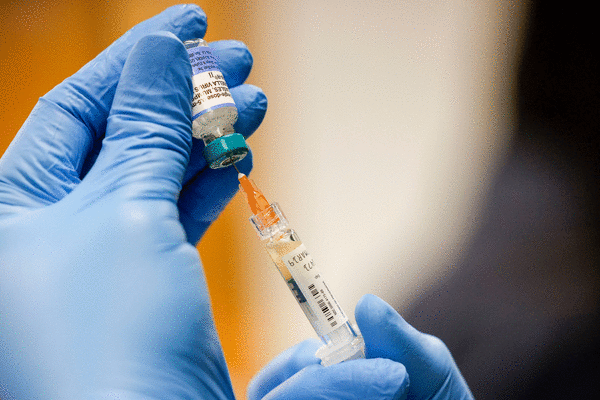
Maryland has reported six times as many mumps cases in early 2026 as it did all of last year, with most infections concentrated in the Baltimore metropolitan area, state health officials said Thursday.
The Maryland Department of Health (MDH) reported 26 cases — 19 confirmed and seven probable, compared with four cases for all of 2025. (The Centers for Disease Control erroneously reported that Maryland had nine cases last year. After being asked about the discrepancy by The Baltimore Sun, MDH said they contacted the CDC to correct the error.)
“The overall risk to the public is considered low given Maryland’s high vaccination rate against the disease,” MDH officials said in a statement. It is not yet known whether the cases are linked, but state and local health officials are investigating.
MDH guidelines define a mumps outbreak as two or more linked cases in a 25-day period where at least one is lab confirmed.
At the end of January, five other states across the country reported cases of mumps, including Alabama, Florida, Indiana, Nebraska and Virginia, according to the CDC. None reported more than three at the time. There have been under 450 mumps cases nationwide each year over the past five years, CDC data show.
What is mumps?
The viral illness typically involves fever, pain and swelling of the cheeks and jaw, and typically lasts between three and seven days, a memo issued Wednesday from the Maryland Institute for Emergency Medical Services Systems says.
The Centers for Disease Control recommends those infected limit their contact with others for up to five days after the swelling begins and should not go to social events, school or work.
“We’ve not identified any presumptive or confirmed mumps cases that have affected EMS,” said Dr. Timothy Chizmar, state EMS medical director. Most mumps patients would be stable enough to go to a doctor’s office, he said, so “we wouldn’t anticipate a bunch of 911 calls out of these cases.”
Vaccination rates
Although reported cases fell by more than 99% since vaccination began for the disease in 1967, mumps cases and outbreaks have ticked back up since 2006, primarily in young adults and vaccinated people, the CDC says on its website. Outbreaks can occur at schools, universities and correctional facilities, it says.
In the 2024-2025 school year, kindergartners came in with less vaccinations than the year before: 92.5% got the combined measles-mumps-rubella vaccine. Nearly 2% of Maryland kindergartners received non-medical vaccine exceptions last academic year.
The mumps vaccine is 85% effective, meaning it’s possible to still contract mumps after being fully vaccinated, said Dr. Geeta Sood, an associate hospital epidemiologist at Johns Hopkins Bayview Medical Center and assistant professor of medicine.
“Most vaccines aren’t sterilizing,” Sood said, “Meaning for most vaccines, it doesn’t mean that you won’t get the infection at all, but it does mean you are much … less likely to get severely ill and to have severe complications from that particular infection.”
Complications from mumps can include encephalitis, deafness and testicular swelling, Sood said.
What to know
Mumps is spread through saliva or respiratory droplets from the mouth, nose or throat, but is less transmissible than COVID-19 or measles, according to Sood.
“Because it’s more likely to spread by droplet, it means that it’s … much more likely to be spread by close contact, like within three to four feet of somebody, and through what we call fomites, like contaminated tissues,” Sood said.
Some people may have asymptomatic infections or have non-specific symptoms without the disease’s signature swelling, but can still spread the virus. Symptoms appear two to four weeks after being exposed, according to the Maryland Health Department.
The EMS memo advises emergency medical clinicians to wear a surgical mask, gown, gloves and eye protection when suspecting mumps. Patients with suspected mumps should also be asked to wear a mask, the EMS memo reads.
Adults aren’t usually recommended to get a booster for the measles-mumps-rubella vaccine, though they might be recommended in the context of an active outbreak, according to Sood.
The CDC still recommends all children get vaccinated for measles, mumps and rubella despite recent changes to the recommended childhood vaccine schedule.
Regardless of the politics or policy surrounding vaccinations, “the science has not at all changed,” Sood said.
_____
©2026 Baltimore Sun. Visit baltimoresun.com. Distributed by Tribune Content Agency, LLC.







Comments