James Stavridis: Iran can turn the Persian Gulf into a minefield
Published in Op Eds
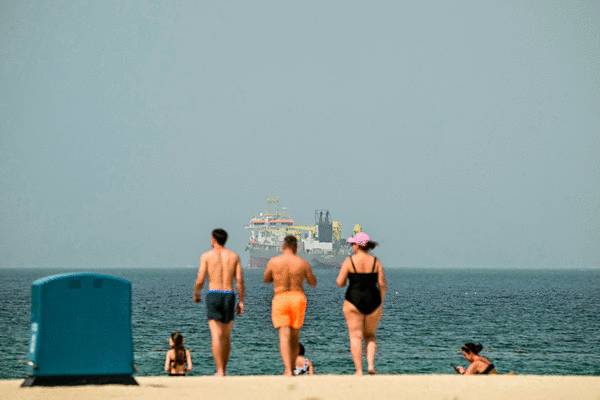
As war rages across the Middle East, every mariner’s eye is on the Strait of Hormuz. This narrow waterway, which connects the confines of the Persian Gulf with the open waters of the Indian Ocean, is effectively shut down.
Normally, about 20% to 25% of the world’s oil and gas flow south from the Gulf and on to markets around the world. As Bloomberg Opinion’s Javier Blas points out, a portion of the crude could get out via land-based pipes, but the disruption is still significant and will only get worse as time goes by.
Iran has effectively closed the strait through a combination of threats from short-range ballistic missiles arrayed along the coast, missile-armed gunboats and high-speed small craft armed with machine guns and rocket-propelled grenades that can swarm large, lumbering tankers. That trio of threats alone is enough to spook the insurance industry, which has essentially stopped backing shipments. President Donald Trump, in a social media post, has pledged to provide political risk insurance “at a very reasonable price” to ships transiting the strait, but he provided few details. For now, the masters of many of the civilian ships are simply anchoring and awaiting instructions from nervous shipping company headquarters.
How long can Iran keep the Strait of Hormuz shut down? What can the US and its allies do about it?
I have sailed through the strait as a Navy officer dozens of times, going back to the late 1970s. It is a very difficult passage just as a matter of marine navigation. I’ve done the transit under risky circumstances similar to today’s conditions back in the mid-1980s, escorting tankers during the Iran-Iraq war as part of Operation Earnest Will. We often had Iranian missile-targeting radars lighting up our ship and their fighters buzzing us overhead.
As a tactical action officer, with the authority to release weapons, I was a nervous young mariner. I also led convoys of merchant ships that we had re-flagged as US vessels, a strategy that is probably under consideration today.
The US military is working hard to degrade Iran’s naval capabilities. The Islamic Revolutionary Guard Corps naval base at Bandar Abbas has been under assault, and according to the Pentagon nearly 20 Iranian vessels have been sunk, one by a US submarine in the Indian Ocean. But that may not be as devastating as it sounds: Iran started the war with a dozen frigates and corvettes, a couple of dozen fast attack and patrol boats, and hundreds, if not thousands, of the small “fast mover” speedboats that can harass civilian shipping. And many of those ballistic missiles along the shores of the strait are still very much in play.
Until the Pentagon can take out far more of the threat, it is unlikely that merchant vessels are going to want to risk the transit, insured or not. And even if Iran’s naval forces are severely degraded, there remains a different, very tricky kind of lethal threat: mines.
Iran used mines four decades ago against Saddam Hussein’s Iraq. It has been planning a Strait of Hormuz closure operation for decades and probably has more than 5,000 mines; just one hit can severely damage a thin-skinned tanker. The Iranians can lay them covertly with small boats, diesel submarines and even civilian craft such as the ubiquitous dhows of the Gulf. If the US does not destroy the mines in port now, and the Iranians lay a large number of them in the strait, the most valuable ship in the Gulf will become a minesweeper.
The US has around three to six minesweepers in the Gulf, and our allies and partners — including Saudi Arabia and Great Britain — could contribute about the same. We could also use MH-53E Sea Dragon helicopters. The Navy’s Task Force 59 in Bahrain, which focuses on robotics and unmanned vehicles, has been experimenting with minesweeping technology as well.
A minesweeping flotilla is vulnerable and could only be employed after the Iranian maritime threat was fully neutralized. And believe me, in the best of circumstances, minesweeping is a very slow business. I have watched US craft, the best in the business, take weeks to clear an exercise minefield of a few hundred mines. The technology to find the mines (sonar and magnetic sensors) is cumbersome and can be unreliable, depending on the state of the sea. Drifting mines become particularly dangerous to the minesweepers themselves.
The sweeps would try to clear an initial channel, but assuming the Iranians used mostly floating mines (not fixed to the seabed), the ships would have to more or less continuously clear the channel. Fully clearing the strait could take a couple of months.
The Navy needs more minesweeping capacity around the globe. But for now, the situation in the Gulf is critical and calls for additional sweeps, aircraft and Littoral Combat Ships fitted for mine clearing. Both the sweeps and the aircraft can be loaded onto larger ships, and some are probably moving to the Gulf already. The LCS are fast-moving warships, and some will be in or headed to the region already. They can’t get there soon enough — the world’s energy supplies demand it.
____
Stavridis is dean emeritus of the Fletcher School of Law and Diplomacy at Tufts University. He is on the boards of Aon, Fortinet and Ankura Consulting Group.
____
This column reflects the personal views of the author and does not necessarily reflect the opinion of the editorial board or Bloomberg LP and its owners.
James Stavridis is a Bloomberg Opinion columnist, a retired US Navy admiral, former supreme allied commander of NATO, and vice chairman at Carlyle.
©2026 Bloomberg L.P. Visit bloomberg.com/opinion. Distributed by Tribune Content Agency, LLC.





















































Comments