Vahe Gregorian: Mourning the joyous Terrance Gore, who had unique, cherished role in Royals lore
Published in Baseball
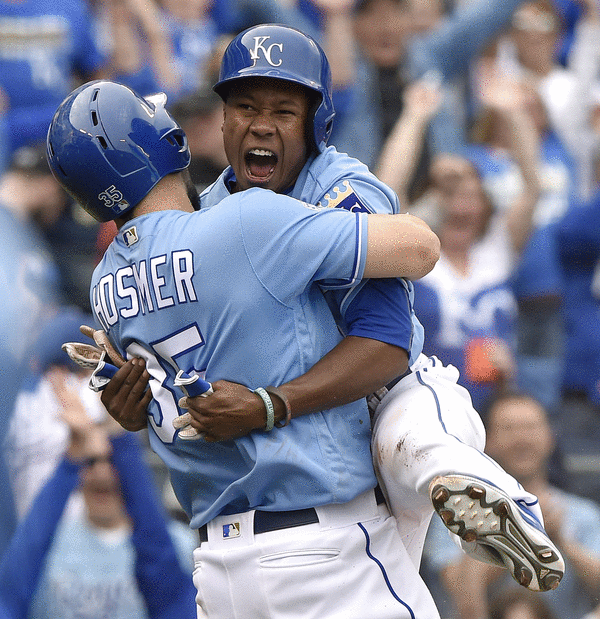
KANSAS CITY, Mo. — For all the Chiefs have achieved in the Patrick Mahomes era, I’m not sure any of that has eclipsed the sheer euphoria of the Royals’ back-to-back World Series seasons in 2014 and 2015 after not so much as appearing in the playoffs since 1985.
The implausibility of it all was part of the exhilaration, to be sure. But it was all amplified by the sense of connection with a team of charismatic players we’d watched grow up before our eyes.
The true magic was in how real and relatable and among us that team felt, a sensation not limited to but epitomized by Eric Hosmer effectively turning on a bat-signal to fans by posting this on Twitter after they swept the Angels in the 2014 American League Division Series: “KC you guys showed us so much love all year (we’re) returning the favor for you guys tonight at @McFaddensKC #allonebigfamily see.u all there.”
What was also beautiful about those teams was that they seemed to be more than the sum of their parts, teeming with very good players but few you’d call superstars. Every role mattered.
Which brings us to the ever-radiant Terrance Gore, who died Friday at age 34 after what his wife, Britney, on X described as “complications after what was supposed to have been a simple procedure.”
The family is “lost” she added, their hearts shattered. And one of their three children, Skylyn, said, “i don’t have a daddy any more, he’s up in heaven in the stars.”
None of us can know the profoundness of their loss. But certainly we can join them in memorializing Gore and thinking about him and the enduring meaning of his time here as part of something so special.
Certainly, we can think about it the way former general manager Dayton Moore did at Yordano Ventura’s funeral in the Dominican Republic in 2017: In a small room near Ventura’s casket, he consoled family members by telling them he and the Royals were “honored to share in this sorrow and pain with you.”
While Gore went on to play for three other franchises and was on other World Series-winning teams in Los Angeles and Atlanta, no doubt he will be Forever Royal because of both his roots with the franchise — a 20th-round draft pick in 2011 — and the particular time and place and circumstances of his first term here (2014-2017).
“Terrance was an unforgettable part of our organization with a unique talent that catapulted him to some of the biggest moments in Royals history,” Royals general manager J.J. Picollo said in a statement. “While his speed and athleticism were what most people immediately noticed, those of us who had the opportunity to know him also remember his energy, his humility and the impact he made in big moments on the game’s biggest stage.”
A sad ending, he added, “to an incredible story.”
The 5-foot-7 Gore never managed to become an established big league hitter, mustering just 16 hits in his career and not managing his first until his fifth MLB season. But his warp speed and the tutelage of Royals coaching guru Rusty Kuntz made him an X-factor in how those Royals could unnerve teams on the basepaths.
That was whether by stolen bases, seizing extra bases or just an implied threat that at times compelled opposing defenses (see: Baltimore in the 2014 AL Championship Series) to put on shifts that left them otherwise vulnerable and off-balance.
In some ways, Gore’s numbers don’t match the aura of what he inflicted.
In five regular seasons with the Royals, including his return in 2019, he had 34 steals and was caught nine times. In his two postseasons with the Royals, Gore had four steals and was caught once.
But he was a distinct element of something bigger than himself, an at-times catalyst and beloved teammate and fan favorite whose playful demeanor was part of the infectious joy of those teams.
Like the best of sprinters, he was proud of his speed. After the Royals clinched the 2015 World Series by beating the Mets in Game 5, Gore joked that he’d run so fast to the mound to celebrate that he arrived before Wade Davis’ glove even came down.
Earlier that season, he stood at his locker jokingly talking about whiskey before reaching for a bottle and showing it off.
“Here it is,” he said, before producing something called “J.R. Watkins Pain Relief Liniment.”
The product that touted itself as “fast-acting heat that provides temporary relief for minor aches and pains” was one of the keys to how he could get warmed up fast for pinch-running, he said.
Not that he felt he needed anything extra.
If he ever got thrown out, he said that day, it wasn’t because somebody bested him.
“I got myself out. You didn’t get me out,” he said, smiling and adding that the only way he could get erased was if he got a bad jump, fell or “might drop my glove, might want to pick it up.”
He’ll always be treasured here for all that helped lead to, of course.
But also for how he could light up a stadium and a room in other ways.
“Known for his great speed but even more so for his kindness and joyful smile, Terrance will be remembered as a tremendous teammate and a dedicated family man,” the Omaha Storm Chasers (the Royals’ Triple-A affiliate) posted on X.
Moore, now the Texas Rangers’ senior advisor of baseball operations, issued a statement about Gore on Saturday afternoon.
“We are all heartbroken to hear the devastating news …” he wrote. “He was deeply devoted to his beautiful family. We are all hurting (for the family) during this incredibly difficult time.
“Terrance brought a high level of excitement and anticipation to the game. He was unstoppable as a base stealer, and he inspired athletes throughout our country to pursue baseball
“He was loved and respected by his very special teammates, who will continue to love his family during this time of sadness.”
Because that time binds them all together and still holds us all together in some way — including now, alas, in the honor of trying to mourn him together, too.
©2026 The Kansas City Star. Visit kansascity.com. Distributed by Tribune Content Agency, LLC.




Comments