Health officials have new advice on what fish are safe to eat in Minnesota
Published in Outdoors
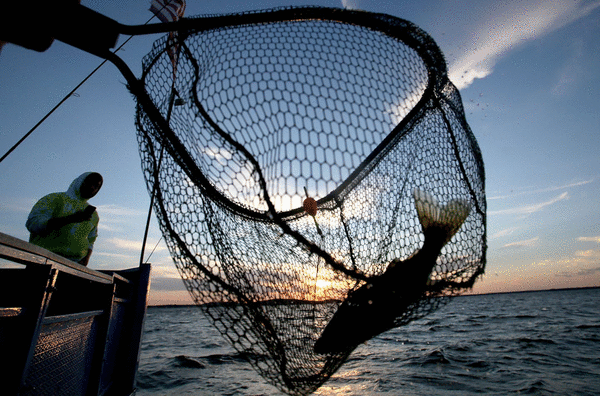
MINNEAPOLIS — The Minnesota Department of Health has new recommendations on what anglers and their families should eat after a day out on the water, applying a broad framework to almost every waterbody in northeastern Minnesota.
The recommendations for Cook, Lake and St. Louis counties cover some of Minnesota’s most popular areas for outdoor recreation, including the Boundary Waters Canoe Area Wilderness and Voyageurs National Park. In this region, historical fish sampling data shows some of the highest mercury concentrations anywhere in the state.
The new recommendations replace previous lake-by-lake advice.
And south of the Twin Cities, there’s a fresh warning about PFAS, also known as “forever chemicals,” in fish for the Vermillion River north of the Hastings Dam.
The Minnesota Department of Health (MDH) issues advice for two groups of people: sensitive populations (children under 15 and people who are pregnant, breastfeeding and planning to breastfeed) and general populations (everyone else).
“Fish are a part of a nutritious, well-balanced diet and part of Minnesota tradition and culture,” said Angela Preimesberger, a research scientist who helped develop the new guidelines. “We’re trying to reach as many people as possible to just make it a habit to check our guidelines before you’re fishing.”
New advice in northeastern Minnesota
For sensitive populations, the MDH now recommends:
— A maximum of one serving per week of bullhead, crappie, inland trout, cisco, lake whitefish and sunfish (including bluegill).
— A maximum of one serving per month of bass, catfish, lake trout, northern pike under 26 inches, walleye under 18 inches and any other fish not mentioned.
— Not eating any muskie, northern pike over 26 inches or walleye over 18 inches.
For general populations, the MDH now recommends a maximum of:
— Four servings per week of bullhead, inland trout, cisco and lake whitefish
— Two servings per week of crappie and sunfish
— One serving per week of bass, catfish, lake trout, northern pike, walleye, yellow perch and any other fish not mentioned.
— One serving per month of muskie.
Why recommendations changed
Preimesberger said state health officials thought the new guidelines would be easier to follow and are in line with the agency’s longtime advice to eat smaller fish to avoid mercury exposure.
The new approach analyzed several decades of data collected through the state’s Fish Contaminant Monitoring Program. Since the late 1960s, the MDH, the Minnesota Pollution Control Agency (MPCA) and the Department of Natural Resources have collaborated to catch and test fish for mercury and other contaminants of concern.
Preimesberger said the new analysis, which was first laid out in a 2024 paper, means “we could reduce the number of lakes that we need to test each year and still keep a very accurate measurement of mercury, and therefore our guidelines and MPCA’s work as well.”
Still, the MDH adjusted its formula in some places shortly after the launch of the new guidance. Preimesberger said that after questions from the Minnesota Star Tribune and other news outlets, the MDH decided to lower the length limits on walleyes to 17 inches for sensitive populations in seven lakes. Data showed the shorter length was necessary to avoid consuming too much mercury in the following lakes:
— Mit, in Cook County
— Crane, in St. Louis County
— Colby, in St. Louis County
— Esquagama, in St. Louis County
— Lower and Upper Comstock, in St. Louis County
— Lower and Upper Pauness, in St. Louis County
— Ole, in St. Louis County
Terry Grosshauser, a board member of the Vermilion Lake Association in St. Louis County, said the MDH has done “a much better job” explaining how size is connected to risk in the new guidelines.
Even though he’s not in the sensitive group, he still wouldn’t eat larger walleyes out of Vermilion. The lake has limits on taking the fish between 20 and 26 inches, but above that size, they can technically be kept.
“I wouldn’t eat them at all,” Grosshauser said.
Where the mercury comes from
Mercury is a global pollutant that doesn’t respect boundaries. It is carried in the atmosphere, primarily from coal plants and other industrial sites. It’s also emitted locally in northeast Minnesota, from taconite processing facilities on the Iron Range and the Boswell Energy Center, a coal-fired power plant in Cohasset.
How much ends up in fish, however, depends on other factors. The cold, tannin-stained waters of the northwoods are ideal for bacteria to convert the element into methylmercury, the form that builds up in slow-growing predators like walleye and northern pike. The MDH used water quality data to inform its mercury analysis, Preimesberger said, to account for the unique factors that make contamination such an issue in northeast Minnesota.
However, the agency did not look at the concentration of sulfate, a mineral salt that leaks from taconite operations, power stations and sewage sites, which can also lead to more methylmercury, in some situations.
At the same time, the Trump administration has given power plants and taconite plants more leeway in not meeting mercury limits set under the previous administration.
That federal pullback means the state needs to step up with more measures to address mercury, said Paula Maccabee, of the environmental group WaterLegacy. “The biggest problem is Minnesota has not made progress in making our fish safe to eat,” she said.
Dan Ruiter, a spokesperson for the MPCA, said the agency had made some progress on mercury reduction from a statewide limit.
He added that mercury levels in northeastern fish have risen slightly since 1990, but that trends in sampling data “are still fairly inconclusive as far as providing a clear signal” on whether fish contamination is continuing to get worse.
New warning on Vermillion River north of Hastings
The MDH also issued new warnings about fish consumption on the Vermillion River, its headwaters and tributaries in Dakota and Scott counties, north of the Hastings Dam. Because of PFAS contamination:
— Sensitive populations should not eat any fish, of any size, from the river.
— General populations should only eat one serving a month of any fish, of any size, from the river.
The Vermillion River is a notable fishery for anglers in the metro area, said Chris O’Brien, of the Twin Cities chapter of Trout Unlimited. There’s a self-sustaining brown trout fishery, which is only catch-and-release, and a population of rainbow trout that are stocked annually and can be taken home.
“I think there’s a lot of families fishing [around the Vermillion River], and a lot of kids getting excited about keeping their trout that they catch,” O’Brien said. “It’s definitely a loss in recreational opportunity for sure.”
Where PFAS comes from in Vermillion River
Ruiter wrote that the MPCA “has not identified a specific source of PFAS in that area. These chemicals can come from industrial activity, wastewater discharges, and old contaminated sites, to name a few.”
PFAS, or per- and polyfluoroalkyl substances, are man-made chemicals that don’t break down in the environment and build up in the bodies of people and animals. Some PFAS have been linked with serious illnesses and cancers, like PFOS, the particular chemical that has shown up in fish in the Vermillion River.
O’Brien wondered whether groundwater contamination might be contributing to the issue in the river. The Vermillion River is a viable trout fishery, he said, because of many interconnections with groundwater. Those natural springs help keep the water cooler in the summer and warmer in the winter.
Underground plumes of PFAS have created drinking water issues for many communities in the east metro. Contamination in that region is the result of mishandled chemical waste from 3M, which pioneered PFAS chemicals in the last century.
____
©2026 The Minnesota Star Tribune. Visit at startribune.com. Distributed by Tribune Content Agency, LLC.





Comments