Dennis Anderson: To Cuba for bonefish, tarpon and permit, with a side of a changed Havana
Published in Outdoors
CAYO LARGO, Cuba — In 1950, Ernest Hemingway founded a billfish tournament off the northern coast of this island nation, not far from Havana. Trolling heavy lines behind his 38-foot boat Pilar, Hemingway won the competition that year. “There is great pleasure in being on the sea,” Hemingway would write, “in the wild suddenness of a great fish.”
Anchored on a mothership some 50 miles off the Cuban mainland, near one of its 4,000 islands and keys, seven of us knew that feeling, the wild suddenness of great fish.
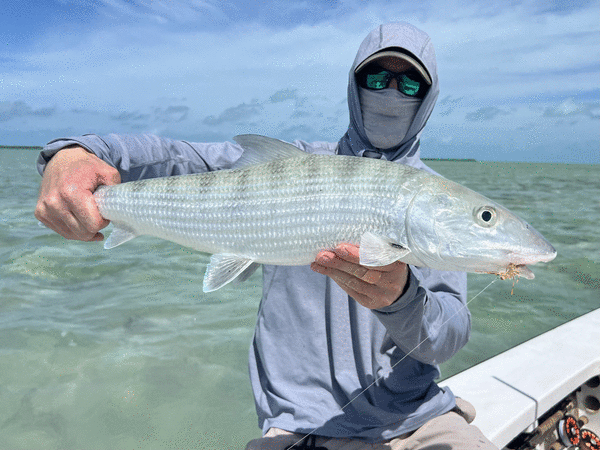
Instead of dragging baits for marlin, we were casting flies to bonefish, tarpon and permit; fish that, ghostlike, appeared and disappeared in the tides that rise and fall on Cuba’s extensive saltwater flats.
“There! Bonefish!” our guides would say when they spotted an elongated, silvery fish in the clear water.
This might happen in the morning, when the increasing angle of daylight made the fish more visible, or in the afternoon when, beneath a hot sun, the caps on our heads and the buffs covering our faces were soaked with sweat.
“Got it!” we would say when we also saw the fish.
Then we would estimate the fish’s distance from the boat, loop line into the air and cast in the fish’s direction. Sometimes the fish was 30 feet away, 40 feet or even 50 feet.
The goal was to land a fly near the fish’s nose, where rejection wouldn’t be an option. But sometimes the wind threw the fly off course. Sometimes we misjudged our distances. And sometimes the fish just didn’t bite.
But if we did hook up — say to a bonefish — line peeled from our reels as if tethered to a torpedo. Hooked permit similarly zinged our lines toward the horizon, while tarpon, born jumpers, tail-walked once, twice, three times before pouting in deeper water, demanding to be broken off or winched to the surface.
Along with me last month were Keith Withycombe, John Ward and Matt Evans, all from the Phoenix area; Frank Gwynn of Fremont, Calif.; my son Trevor of Missoula, Mont.; and Mike McGibben, who lives in Hawaii.
Each had fly-fished in saltwater previously, and each had passed many hours daydreaming about fishing when they should have been working or otherwise paying attention, such as at weddings and funerals.
Each also, as I did, had reservations about traveling to Cuba at a time of blackouts and shortages. Headquartering so far from medical and other help also was a concern.
But these were outweighed by our desire to cast to big fish, and to see new places and to meet new people.
Regarded as a trophy destination by anglers worldwide, Cuba is a fishing paradise in part because hundreds of square miles of its coastline are protected as marine reserves. Only fly fishing is allowed in these areas, and access is limited to anglers who book with approved vendors. All caught fish are released.
In a poor country made poorer in recent months, where many Cubans have lost not only their jobs and transportation but the food in their refrigerators, the presence of such pristine areas is a paradox.
Nature is abundant but little else.
At 8:30 each morning, we clambered into skiffs, one guide and one angler to each, leaving the mothership to fish. Even at that early hour, the air was warm and our blousy hoodies and light pants fluttered as our guides — Amaury, Vera, Alexis, Frank, Alex and Yarito — started the skiffs’ outboards and fanned the smaller craft in a watch-face of directions.
Trailing foamy wakes, the skiffs rose atop water hued aquamarine, turquoise and sapphire, as pockets of turtle grass undulated below.
“There’s one!” is what we came for.
Our trip had begun with a flight from Miami to Havana, a city whose eclectic limestone buildings bear the weathering of centuries.
With no flights from Canada, Russia or Europe, most of the usual tourists were gone, deflating, it seemed, the city’s pulsating salsa and creole beats. Even Calle Obispo, one of Havana’s more happening streets, was taking a breather.
We had rented a two-story casita along the Malecón, a noteworthy roadway and promenade that Trevor and I strolled casually one day, basking in sunshine while watching water lap gently against the seawall.
On adjoining streets, colonnades propped up balconies, from which Cuban men and women, some smoking, peered down on the day’s comings and goings.
In the 1920s and 1930s, during U.S. Prohibition, rum runners left Havana destined for Key West and other points north. One can imagine a livelier Cuba then, with humid nights, heavy drinking and danger in the air. Money could be made by crossing the Gulf Stream with a shipload of hootch. Decades later, ironically, Cubans themselves would become the cargo, 125,000 of them fleeing to the United States in 1980 alone during the Mariel Boatlift.
Not far from our place on the Malecón, I saw a boy, maybe 6 years old, and his younger brother, both watched by their mother, who sat in the stoop of a narrow doorway.
The older boy was swinging a plastic bat at a rubber ball, and when he hit the ball it rolled into the street, the Malecón. Seeing this, I fielded the ball, and with a hand motion introduced myself as an available pitcher.
Baseball is Cuba’s top sport, and Twins legend Antonio Oliva Lopez Hernandes Javique, better known as Tony Oliva, is one of many Cubans who have made it to the majors. This boy, I thought, could be next.
As I wound up, the younger boy clapped and jumped, and the mother of the two boys laughed. This wasn’t a manicured ballpark with precise foul lines and a cheering crowd. This was Havana, with its tired buildings and empty streets. But the boy with the bat was all about it, his arms and wrists locked and loaded.
When my pitch reached the imaginary plate, the boy clubbed it. Playing the outfield, Trevor fielded the ball, scrambling into the Malecón. But this was a home run, a round-tripper, and when I pitched the ball again, the boy hit it again, and again and again, and soon he was smiling broadly.
When we left, not for any reason other than friendship, Trevor gave the mother $20, about half of what a Cuban doctor makes in a month.
The mother smiled and Trevor and I turned away, waving.
Soon enough, Julio, our driver, would pick us up in his pink ’55 Plymouth convertible. With the top down on his cool ride, he’d drive us to a bus, which would take us to our docked mothership, four hours from Havana.
It was time to fish.
When not in use, the 7-, 9- and 10-weight fly rods used to fish Cuban waters for bonefish, tarpon and permit were stored safely. Right: The Trump administration's oil embargo has dramatically reduced vehicle traffic on Cuba's roads and highways. But a few for-hire drivers in Havana, like this one in his customized 1955 Plymouth convertible, are still on the road.
Now it was the last of our seven days on the mothership, and a minor tempest buffeted the skiffs against the stern of the larger boat as we left in the morning to fish.
Roiling the surface of the shallow water, the wind would obscure easy sightings of tarpon, bonefish or permit. Still, the seven of us fanned out in the skiffs, each in a different direction, seeking refuge behind mangrove thickets and in the lee of small islands.
As they did every day, our guides climbed atop their poling platforms on the skiffs’ sterns while we braced ourselves on the bows, fly rods in hand.
Moving silently along the flats, propelled by the guides’ long poles, this was as much hunting as fishing. If you saw a fish and you cast to it and missed, it was like leveling a scope’s crosshairs on a deer, and missing. You thought about it afterward.
On previous days, Keith and Matt had caught permit in addition to bonefish and tarpon, a tough combination to hook, with permit being the toughest. Frank, Mike and Trevor also had laid into good fish, and John had landed a bonefish we estimated at eight pounds.
Always at day’s end, when our skiffs pulled alongside the mothership, Eysa, the mothership’s boss, greeted us with a smile and damp towels to wipe our faces. She also brought mojitos, which went down easy.
Stashing our rods, 7-, 9- and 10-weights, we cleaned up for dinner while the guides gathered in the boat’s bow, speaking Spanish excitedly.
The guides were friendly and highly skilled, as were Eysa and the other staff, and we invited them to visit us in America. But they knew it would never happen.
On this last day, Alexis, my guide, shouted, “There’s one! Bonefish!”
Making the cast, I caught the fish.
After which, in a short while, the mothership’s captain weighed anchor and for six hours we pitched and rolled in rough seas, watching for the Cuba mainland.
____
©2026 The Minnesota Star Tribune. Visit at startribune.com. Distributed by Tribune Content Agency, LLC.





Comments