ICE detained a pregnant woman. She went months without proper care
Published in Women
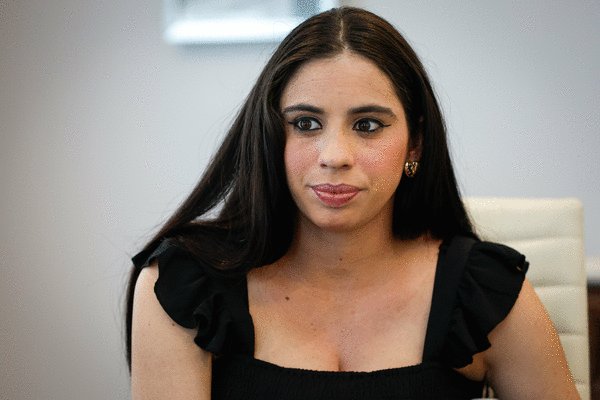


TAMPA, Fla. — There was no mirror in the detention center to see her baby bump form, so Amanda Cardoso placed her hands on her abdomen and imagined.
Cardoso, 22, had immigrated from Cuba to Tampa in 2023. She was seeking a haven after her grandmother was killed in an act of political violence.
Cardoso, who’d been studying to be an art teacher, envisioned a future in the United States free from persecution — a place to raise a family. When she learned she was pregnant in August, she longed to fill her home with baby clothes and build a crib.
But weeks into her pregnancy, Cardoso was swept up by U.S. Immigration and Customs Enforcement agents. During months of detention with few medical checkups, Cardoso didn’t even know how many weeks along she was.
She was in Florida lawfully under a rule that lets Cubans who have been in the U.S. for at least a year apply for permanent residency. She had a pending green card application. Still, Cardoso was shipped to a South Florida detention center. Days later, she was transferred out of state. By late September, she made a third stop in rural New Mexico. She’d stay for months as her body changed and her baby grew.
Medical experts agree that detaining people during pregnancy poses major safety risks, and immigration policy states that doing so should be extremely rare. But amid the Trump administration’s push for mass deportations, advocates say experiences like Cardoso’s indicate a disregard for the health of women and children.
ICE officials did not respond to questions about the agency’s policies regarding pregnant detainees or the specifics of Cardoso’s case.
“I felt afraid,” Cardoso told the Tampa Bay Times in Spanish. “Afraid for me, afraid for my baby because I could lose it.”
Left in the dark
Cardoso was kept in South Florida for half a month.
Prenatal care was sparse, she said, and so was information about her health. One day, she felt faint and nearly passed out.
Staff took her to a hospital, where she got an evaluation, but she said she wasn’t given access to her medical files or told about the health of her baby before she was returned to her cell.
It was just weeks earlier that she had been arrested in a parking lot of an Orlando shopping center. She had been there with four friends when two were caught stealing sunglasses. Security footage later showed Cardoso wasn’t with them at the time, but police took her into custody anyway. Records show she was charged with coordinating theft. Her attorney is filing a motion to dismiss the case.
Shortly after her arrest, ICE stepped in.
In 2016, ICE policy discouraged the detainment of pregnant women, but two years into the first Trump presidency, the agency reversed course. Leading medical groups, like the American Gynecological Association and American Academy of Pediatrics, condemned the decision.
“All pregnant women and adolescents held in federal custody, regardless of immigration status, should have access to adequate, timely, evidence-based, and comprehensive health care,” their joint letter read. “The conditions in DHS (Department of Homeland Security) facilities are not appropriate for pregnant women or children.”
In 2021, the Biden administration reissued the directive, noting that pregnant women should be detained only in extraordinary circumstances, such as when they pose a danger or a flight risk. ICE must then monitor detainees’ health, give them comprehensive pre- and postnatal care and evaluate each week whether detainment is still appropriate.
Though the second Trump administration has yet to officially rescind those directives, reports and public records indicate a pileup of concerning cases.
There was the 17-year-old from Honduras who was detained in Louisiana last year before being flown to a center in Fort Lauderdale at 36 weeks — beyond the point when doctors advise against flying. There was the woman detained in Broward County who, according to 911 logs, reported a possible miscarriage. Recently, federal judges have condemned ICE’s treatment of pregnant and nursing detainees, citing cramped conditions and mothers being separated from nursing infants.
When Cardoso was moved across the country, she felt alone in the dark.
A risky environment
Before Cardoso arrived at Otero County Processing Center on a swath of New Mexico desert, the place had made headlines when a 32-year-old Ecuadorian immigrant died in custody in June 2024. Authorities released minimal information on his death.
About 30 miles north of El Paso and the Mexican border, the center has held thousands of detained immigrants — and has amassed a history of civil rights complaints and reported violations.
In 2021, ICE personnel wrote a letter to the center’s operating company outlining concerns about inadequate staffing and “standards compliance,” as well as a shortage of medical services. Around the same time, an immigration advocacy group found that the most common complaints from those at Otero concerned medical access.
At Otero, Cardoso knew the living conditions were bad for her baby. Research indicates that stress can make complications like pre-eclampsia and gestational diabetes more likely. But constant commotion and the threat of deportation made stress an inevitability.
To pass time, Cardoso would try to spend her days asleep, rising from the metal bunk bed she shared with another woman only when food was served.
“There were 50 of us in one cell,” Cardoso said. “One room for 50 people.”
On arrival, Cardoso went through medical examinations that were standard for Otero detainees, but she said she went months without specialized care. She said the center didn’t have ultrasound machines to perform sonograms so she didn’t get imaging. Instead, staff placed a stethoscope against her belly to make sure her baby’s heart was beating.
Cardoso said she was not the only pregnant woman at Otero — there were many. Whenever they gathered, she said, all they could talk about was the uncertain future.
As days, then weeks, then months passed, a new fear emerged: What would happen if she gave birth there?
Holding out hope
After nearly three months at Otero, Cardoso said she was taken out of the center for a doctor’s appointment. Clinicians performed an ultrasound and did blood work.
She learned she was having a baby girl.
But once more, Cardoso said, she was denied access to her medical records and given no insight into her health, including how far along her pregnancy was. This was Cardoso’s first pregnancy. She didn’t know what symptoms to look out for or how to keep her baby healthy, especially without the guidance of a doctor.
Regular appointments with specialists are vital to keeping mothers and babies safe, said Dr. Nicole Teal.
Teal, who studied medicine at the University of South Florida, is an OB-GYN who specializes in high-risk pregnancies at UC San Diego Health. She said diagnosing complications and treating them early is crucial. That means getting lab work, imaging and genetic testing, often in the first trimester. Failing to treat complications can be fatal.
“It’s really inhumane,” Tampa immigration attorney Sam Badawi said of Cardoso’s case.
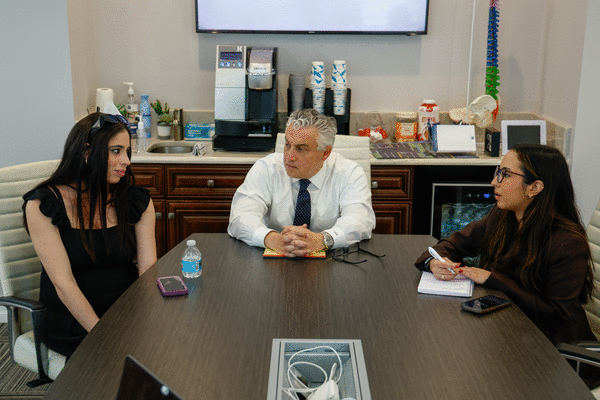
Badawi learned about Cardoso in September after a family member reached out. The lawyer decided to represent her pro bono, getting bar certified in New Mexico to be able to do so. He said her case highlights a substandard level of care for detainees, noting that detention centers are often in rural areas with limited health care and long journeys to hospitals or clinics in an emergency. The New Mexico town where Cardoso was held is designated as a health care provider shortage area, meaning it has too few physicians to meet needs.
Without Badawi’s help, Cardoso said she was likely to be sent to Ecuador via an agreement between the countries that allowed the U.S. to send asylum seekers to places it deems safe. Recently, a federal judge ruled the agreement to be illegal. The issue is likely to go before the Supreme Court. Cardoso had never been to Ecuador. She knows nobody there.
In February, after Badawi filed a challenge to Cardoso’s detainment, ICE temporarily released her. If she’s denied a green card, she could still be deported. And if she is detained again after giving birth, she could be separated from her baby.
“This is far from over,” Badawi said.
Since returning to Tampa, Cardoso has been experiencing post-traumatic stress disorder. She can’t sleep — the mattress feels too soft, her home too quiet, and she has nightmares in which she’s still imprisoned. She flushes the toilet multiple times, a habit from the detainment center where the plumbing was unreliable. Though she returned to a wardrobe that no longer fits, she’s too afraid to venture out to buy maternity clothes.
Recently, Cardoso had an appointment at the hospital where she expects to give birth next month. She said she was diagnosed with pre-eclampsia and gestational diabetes, perhaps triggered by trauma.
She desperately wants to enjoy her early days of motherhood. She said she is trying to be strong and to hold onto hope — for her baby, but also herself.
She is trying.
©2026 Tampa Bay Times. Visit at tampabay.com. Distributed by Tribune Content Agency, LLC.
















Comments